
Additionally, everyone can look around a property and identify visible issues such as cracked tiles. However, using the right Inspection Tools helps professionals uncover hidden problems, including dampness, incorrectly wired sockets, leaking AC ducts that allow cold air to escape into the ceiling, and gaps in villa flooring that may allow groundwater to seep inside.
Therefore, using the right tools you can turn your guess into a fact. Thus, you can provide a report that your developer/landlord/seller cannot really argue with. In this guide we’ll take you through the key tools our inspectors use on every job, what they will identify and why some simple checks like plinth protection are so important in the UAE weather. Whether you are an agent, first time buyer or experienced investor, you will know exactly what to expect from our property inspection service and what to ask any companies.
Why Inspection Tools Matter More Than You Think
Additionally, most serious defects in UAE homes are concealed. Paint can mask damp, ceilings can hide ducts and pipes, and tiles may look flawless while being hollow beneath. Without the proper instruments, an inspector can only guess from what is visible on the surface.
Good inspection tools do three things for you:
- They find hidden faults. Heat, moisture and electrical problems often have no visible sign until damage is done.
- They measure, not guess. A reading of 28% moisture in a wall is a fact. “It looks a bit damp” is an opinion.
- They create evidence. Thermal images, readings and photos in your report make it much harder for a developer or seller to dismiss a defect.
This is the real difference between a quick walk-through and a professional home inspection. You’re not paying for someone’s time. You’re paying for what their equipment and training can find.
The Home Inspection Tools We Use on Every Job
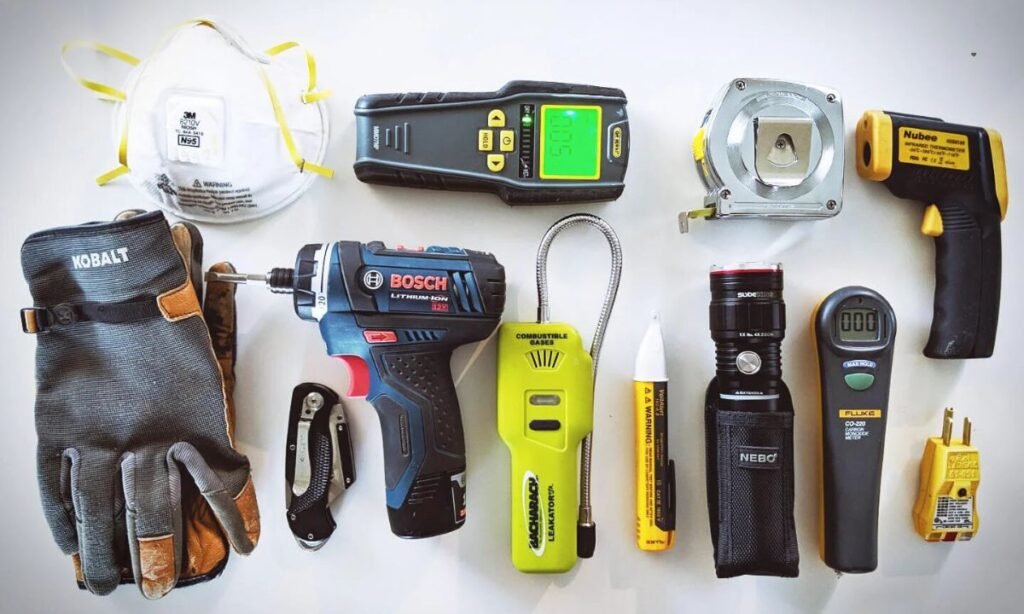
Here’s what goes into our kit bag, and what each tool actually tells us.
1. Thermal imaging camera
This is the most powerful tool we carry. A thermal camera shows the surface temperature of walls, floors and ceilings as a color image.Damp areas appear cooler, allowing us to detect leaks behind tiles without damaging them. It also reveals missing insulation, leaking AC ducts and overheating cables in the DB board. It’s especially useful for spotting AC problems in new homes, which are very common at handover.
2. Moisture meter
A thermal image tells us where to look. A moisture meter confirms it. We press it against walls, skirting, cabinets and wooden doors to get an actual moisture reading. Elevated readings near bathrooms, kitchens, and exterior walls often indicate a leak or compromised waterproofing. If you’ve seen black spots in a cupboard, this is how we find the source of mold rather than just cleaning the surface. For bigger problems we offer a full mold inspection.
3. Socket Tester and Multi meter
Every single socket on site will be tested. A socket tester will show reversed polarity, missing earth and open circuits within seconds. A multi meter can be used to confirm there is a voltage and will help when tracking down any faults. As electrical faults can be dangerous we always carry out this test.
4. Laser Level and Spirit Level
These will ensure that any flooring, work tops, door and window frames are level and square. They will also ensure that shower floors and balconies are sloping towards the drain. If they are not sloped correctly standing water will occur which will lead to leaks.
5. Tap Tool
This is a simple but very effective way of identifying if any tiles are faulty. Tap every tile on the flooring and walls. If the tile makes a hollow noise then there is not enough adhesive underneath meaning it is more likely to crack or come loose.
6. Bore scope Camera
A small camera attached to a flexible cable so we can look into false ceilings, behind access panels and drain pipes without having to open them up.
7. Other everyday tools
- Laser distance meter, to check room sizes against your floor plan
- Water pressure gauge, for taps and showers
- Infrared thermometer, to check AC outlet temperatures room by room
- Drone, for roofs and tall facades that aren’t safe to access
- High-resolution camera and inspection app, so every defect in your report has a photo and an exact location
Plinth Protection: The Villa Check Most Buyers Never Hear About
The plinth is the lowest section of an external wall of a building. A plinth protection system protects the ground from water and salts within the soil entering the external wall and foundation. This can include applying a waterproof material to the lower section of the wall, sloping aprons made from concrete or paving surrounding the building and ensuring the junction between the ground and wall is sealed correctly.
This is very important in the UAE due to high levels of salty groundwater in many areas. Chlorides and sulfates can be found within the soil on the coast. This will gradually affect concrete and steel. Daily watering of gardens will also increase the amount of water directly contacting the walls. Without a strong plinth dampness can occur causing paint to come off and eventually cause corrosion.
What our inspectors check
- Cracks, gaps or missing sections in the plinth coating or apron
- Whether the ground and paving slope away from the building, not towards it
- Damp patches, tide marks or salt crystals (efflorescence) at the base of walls
- Planters, irrigation lines or soil piled up against the wall above the protected level
- Moisture readings on the inside face of ground-floor walls
The moisture meter and thermal camera both play a big part here. Problems at the plinth often show up as damp inside the villa long before anything looks wrong outside.
If we find signs of water damage at the base of the walls, we may recommend a closer look at foundation and structural cracks or a full structural foundation inspection. Damp soil at the plinth also attracts termites, so a termite inspection is often worth adding for ground-floor villas and townhouses.
Building Inspection in Dubai and Across All 7 Emirates
The same core inspection tools work everywhere, but each property type needs a different focus.
- Villas and townhouses: Roofs, plinth protection, external drainage, garden irrigation and boundary walls get extra attention. Our villa snagging covers all of this.
- Apartments: The focus moves to wet areas, AC performance, balcony waterproofing and electrical safety. See our apartment inspection service for details.
- Offices, shops and warehouses: Larger MEP systems, fire safety items and heavy-use floors. We handle these through our commercial property inspection.
A building inspection in Dubai often means new off-plan stock in places like Dubai Hills, Arabian Ranches, JVC and Dubai South. Outside Dubai, the conditions change a little:
- Abu Dhabi: Waterfront homes on Yas, Saadiyat and Al Reem, where sea air and humidity test window seals and balcony waterproofing.
- Sharjah and Ajman: Fast-growing family communities and affordable towers, where plumbing, drainage and AC checks come up most.
- Ras Al Khaimah, Fujairah and Umm Al Quwain: Coastal and resort-style properties, where salt air, roof waterproofing and plinth protection deserve a careful look.
Regardless of the property’s location, follow the same process: test everything, measure what matters, and photograph every finding.
Can You Do It Yourself? DIY Tools vs a Professional Inspection
You can buy a basic socket tester or a cheap moisture meter online, and they’re handy for a quick check. Our pre-handover inspection checklist is a good place to start if you want to walk through your home yourself first.
But there’s a big gap between owning a tool and reading it correctly.
| DIY check | Professional property inspection | |
| Equipment | Basic socket tester, phone torch, maybe a budget moisture meter | Calibrated thermal camera, pin and pinless moisture meters, laser levels, borescope, drone |
| Experience | Usually first time | Hundreds of UAE homes, so patterns are spotted quickly |
| Coverage | What you notice | Every room, every socket, every system |
| Report | Notes and phone photos | Itemised report with photos, readings and locations |
| Weight with the developer | Easy to dismiss | Hard to argue with |
Using a thermal camera to target an area of the wall is easy. You need training to know if the cold spot is a leak, AC vent or shadow. This will help give you results that the developer needs to fix.
Who Gets the Most Out of a Tool-Based Inspection?
First-time buyers
If you’ve never bought a home before, you don’t need to know how any of these tools work. That’s our job. Come along on the day if you can, though. Seeing a leak light up on a thermal camera is the fastest way to understand your new home.
Investors and landlords
For investors, hidden defects eat into returns through repair bills, tenant complaints and empty months. A pre-purchase inspection before buying, especially when buying a resale property, helps you price in problems or walk away. A yearly maintenance inspection keeps small issues small.
Real estate agents
Agents who recommend a reliable inspection build trust and get fewer angry calls after the deal closes. For new handovers, a post-handover inspection during the warranty period also helps your clients get defects fixed while the developer is still responsible.
Frequently Asked Questions
What inspection tools are used in a property inspection in Dubai?
The main tools are a thermal imaging camera, a moisture meter, a socket tester, a multi meter, laser and spirit levels, a tapping tool for hollow tiles and a bore scope camera. Drones are used for roofs and high facades.
What are the most important home inspection tools?
The thermal camera and moisture meter matter most in the UAE, because hidden water and AC problems are the most common and most expensive defects.
What is plinth protection?
Plinth protection is the waterproofing and sloped apron around the base of a building’s outer walls. It keeps salty groundwater and irrigation water away from the walls and foundation.
Does a building inspection in Dubai damage the property?
No. A standard inspection is non-destructive. Thermal cameras and moisture meters can detect problems without drilling into or damaging any surfaces.
How long does a property inspection take?
A one-bedroom apartment usually takes 2 to 3 hours. A large villa can take most of a day.
Do you inspect outside Dubai?
Yes. We inspect properties in Dubai, Abu Dhabi, Sharjah, Ajman, Ras Al Khaimah, Fujairah and Umm Al Quwain.
Book a Property Inspection That Finds What Others Miss
Whilst they won’t do the work for you, there is no point having an inspector who doesn’t have the right tools. When choosing your property inspection company ask to find out what kit they use, do they offer thermal imaging and do they look at things like plinth protection on villas. This can tell you a lot about the quality of the report you are likely to receive.
Our InterNACHI-certified team brings the full kit to every job, whether it’s a studio in JVC or a six-bedroom villa in Abu Dhabi. You get a clear, photo-backed report you can send straight to your developer, seller or landlord.
Ready to see what’s really behind the walls? Book your inspection today, or message us on WhatsApp for a quick quote.
