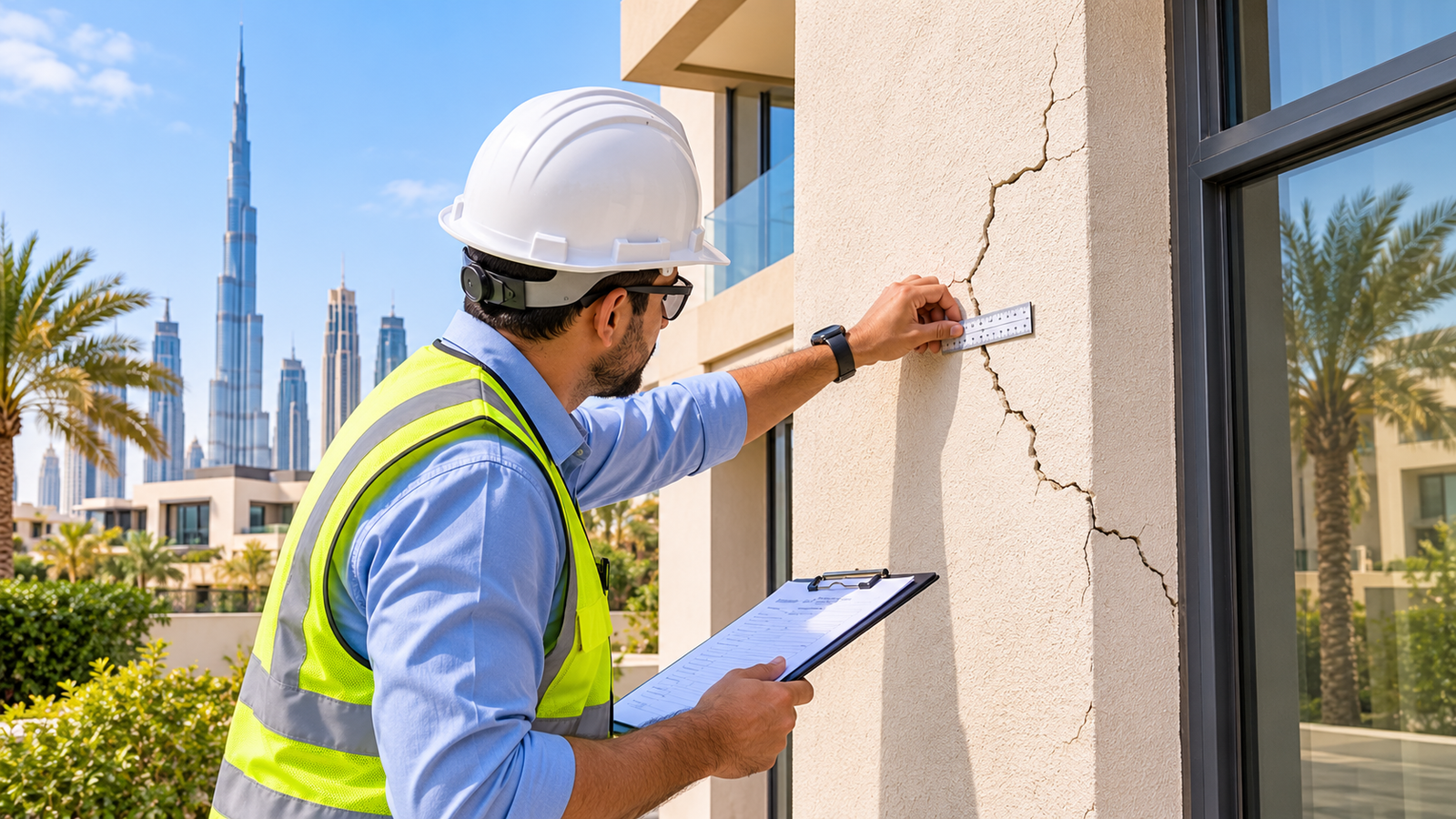
You’ve just purchased either a villa or an apartment and have noticed there is a thin line across the wall above your door. The most common question people ask is whether this is a problem?
In most cases this will not be an issue to worry about however in some situations it can be an early sign that there has been some movement to the foundations or some structural stress. It can be difficult to identify what type of crack you have without a professional structural inspection in Dubai.
Our guide explains crack types, why UAE buildings crack, and when you should arrange a structural survey of the foundations. We wrote this guide for first-time buyers, seasoned investors, and agents who advise on purchases.
Are Cracks in a New Building Normal?
Short answer: some are, some aren’t.
Concrete, block and plaster all shrink a little as they dry and cure. In the first year or two, a new building also settles slightly onto its foundations. Both processes can leave fine hairline cracks in plaster and paint, usually less than 1 mm wide. These are cosmetic. In new UAE buildings, contractors commonly fix these cracks with filler and a fresh coat of paint.
What isn’t normal in a new building:
- Cracks wider than about 3 mm, or ones that keep getting wider
- Diagonal or stair-step cracks running from the corners of doors and windows
- Cracks in columns, beams or the ceiling slab
- Cracks that show on both the inside and outside of the same wall
- Doors and windows that suddenly start sticking or won’t close
If you notice any of these before handover, have them checked before you sign. A pre-handover inspection documents the cracks while the developer is still clearly responsible for them.
Types of Cracks and What They Usually Mean
The direction, width and location of a crack tell an inspector a lot. Here’s a quick guide. Treat it as a starting point, not a diagnosis.
| Crack type | What it looks like | Usual cause | Risk level |
| Hairline (under 1 mm) | Thin, random lines in plaster or paint | Shrinkage as materials dry, heat expansion | Low, cosmetic |
| Vertical | Straight up and down, often mid-wall | Shrinkage or minor settlement | Low to medium |
| Horizontal | Running along the wall, often low down | Soil or water pressure, weak bond in block work | Medium to high |
| Diagonal or stair-step | Angled, often from door and window corners | Uneven foundation settlement | High, needs checking |
| Wide or growing (over 3 mm) | You can fit a coin edge in it, or it gets wider | Ongoing structural movement | High, act quickly |
| Cracks in columns or beams | Lines on load-bearing concrete, sometimes with rust stains | Overload, rebar corrosion, poor concrete | High, urgent |
| Floor and tile cracks | Tiles cracking in a line across a room | Slab movement or poor screed | Medium |
Rust-colored staining around a crack is a red flag. It usually means water is reaching the steel reinforcement inside the concrete, and corroding steel expands and cracks the concrete further.
Why Buildings Crack in Dubai and the Rest of the UAE
UAE conditions are tough on buildings. A few local factors explain most of the cracking inspectors see.
Extreme heat and temperature swings
Walls and roofs can heat well above air temperature in summer, then cool at night. Materials expand and contract every day, and over time that movement opens up joints and weak spots. Roofs, parapets and west-facing walls take the worst of it.
Soil and groundwater
Much of the coastal UAE sits on sandy soil and, in some areas, salty ground known as sabkha. Groundwater can be close to the surface near the coast. Salty, sulfate-rich water damages concrete and steel when foundations are not properly protected. Uneven compaction of fill sand under a villa can also lead to one part of the house settling more than another.
Water leaks
A leaking pipe, failed bathroom waterproofing or a broken irrigation line in the garden can soften the soil under a footing. This is one of the most common causes of wall cracks in villas in Dubai, and the cracks often appear near wet areas or along garden-facing walls. If you also see damp patches or a musty smell, a mold inspection is worth adding.
Workmanship and speed
Fast construction causes concrete to cure too little, crews to miss movement joints, and workers tie block work into columns properly. These issues often show up in the first year after handover.
Wall Cracks in Villas in Dubai: Warning Signs to Watch For
Villas move more than apartments. They sit directly on the ground, they have gardens and pools next to them, and they often have extensions added later. So wall cracks in villas in Dubai deserve a closer look than a hairline in a tower apartment.
Walk around your villa and check for these:
- Cracks where an extension meets the original house. New and old structures settle differently, so this joint often cracks.
- Cracks in the boundary wall or around the pool. These can point to soil movement or a leaking pool shell.
- Gaps between the floor and skirting. A gap that keeps growing can mean the slab is sinking.
- Doors that used to close and now stick. A door frame going out of square is a classic sign of movement.
- Cracks that come back after repainting. If a crack reopens within a few months, the cause is still active.
One simple tip: mark the ends of a crack with a pencil and write the date next to it. Take a photo with a ruler beside it. If it has grown a month later, call a professional. For older villas, a full home inspection will also pick up related problems like plumbing leaks and roof damage.
What a Foundation Inspection and Structural Inspection in Dubai Involves
A proper foundation inspection in Dubai is more than someone looking at a crack and guessing. A qualified inspector follows a clear process and backs up the findings with measurements.
- Visual survey. The inspector maps every crack inside and out, noting its width, length, direction and location. Patterns matter more than any single crack.
- Level and plumb checks. Laser levels show whether floors have tilted or walls have leaned, which points to uneven settlement.
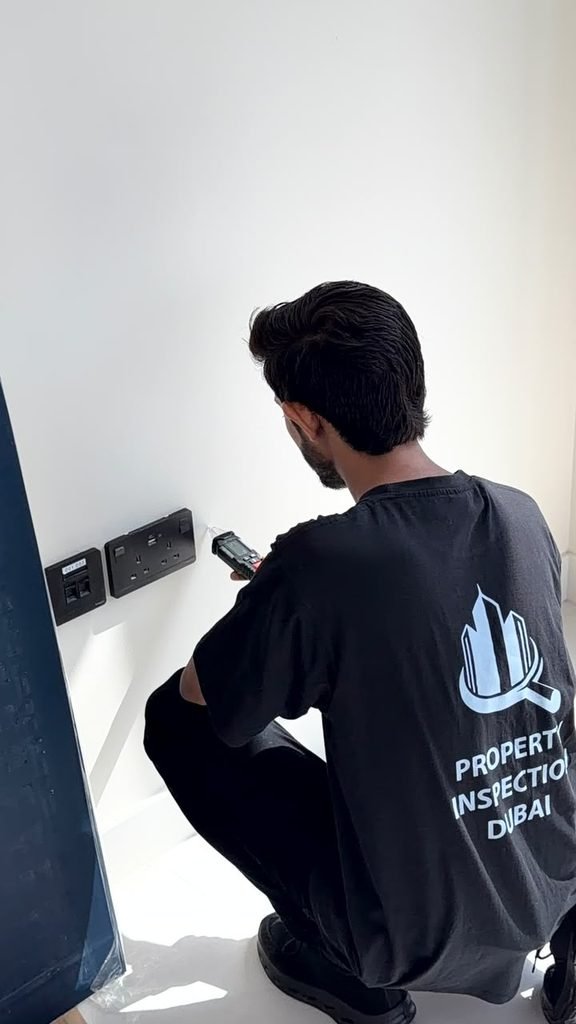
- Moisture and thermal checks. Thermal cameras and moisture meters find hidden leaks that may be washing out the soil under a footing.
- Concrete testing. Non-destructive tools such as a rebound hammer and ultrasonic pulse velocity testing check the strength and quality of the concrete without breaking it.
- Rebar scanning. A cover meter or scanner checks how deep the steel sits in the concrete. If the cover is too thin, rebar corrosion and cracking are more likely.
- Crack monitoring. Technicians fix gauges across cracks and read them over several weeks to determine whether the movement continues.
- Written report. You get a clear report with photos, the likely cause of each crack, and whether it needs cosmetic repair, monitoring or a structural engineer’s design for repair.
When to book a structural inspection in Dubai
- Before buying any resale villa or older building, as part of a pre-purchase inspection
- Before handover of a new property, especially a villa
- During the developer’s defects liability period, through a post-handover inspection
- When cracks appear suddenly, grow, or come back after repair
- After nearby construction, excavation or a major leak
UAE law holds contractors and designers responsible for serious structural defects for ten years after completion. That protection is much easier to use when you have a professional report showing what’s wrong and when you found it.
Structural Cracks Across All Seven Emirates
The causes vary a little from place to place, so it helps to know what’s common where you’re buying.
- Dubai: Large villa communities like Arabian Ranches, The Springs and Jumeirah Park are now 15 to 20 years old. Extensions, pool leaks and ageing waterproofing are frequent causes of cracking.
- Abu Dhabi: Coastal and island areas have high groundwater and salty soil, so concrete protection and rebar corrosion need close attention.
- Sharjah and Ajman: Many older low-rise buildings and villas show cracking from age, past leaks and limited maintenance.
- Ras Al Khaimah: Hillside and coastal sites can have very different ground conditions within short distances.
- Fujairah: Rocky ground near the mountains and heavy seasonal rain bring their own drainage and movement issues.
- Umm Al Quwain: New waterfront projects need the same groundwater and salt checks as other coastal areas.
For offices, warehouses and retail units in any emirate, a commercial property inspection covers structural checks along with MEP and fire safety.
What This Means for Buyers, Investors and Agents
First-time buyers
Don’t panic at every crack, and don’t ignore them either. Ask the seller or developer about any cracks you see, and have them inspected before payment. A report gives you the facts to negotiate the price or ask for repairs.
Investors and landlords
Structural problems hurt rental income and resale value. A crack that’s fixed early with a simple repair costs far less than underpinning a foundation later. Regular maintenance inspections help you catch movement while it’s still small.
Real estate agents
Buyers increasingly ask about cracks during viewings. Recommending an independent inspection builds trust and avoids deals falling apart late. For resale villas especially, a report upfront makes negotiations smoother for everyone.
Frequently Asked Questions
Are small hairline cracks typical?
Small hairline cracks in plaster are common in new properties. However, any cracks wider than 3mm, diagonal cracks from the corners of doors or any cracks in columns or beams should be investigated.
How do I know if a wall is structurally damaged?
Widening, large cracks, diagonal and horizontal cracks, or cracks on both sides of a wall are all warning signs. Doors sticking and slumping floors are also signs. The only way of knowing for certain is to have the wall inspected using the correct tools.
How much does a structural survey cost in Dubai?
The survey will depend on how big the property is, what type of property it is and what testing needs to be carried out. Visual surveys for an apartment will be cheaper than a full survey including concrete testing for a villa. Written quotes can be requested.
How long will a foundation survey take in Dubai?
Most surveys on apartments and villas will take a few hours. If monitoring cracks is required then readings will be taken over a number of weeks.
Can wall cracks in a villa in Dubai be fixed?
Yes. Cosmetic cracks can be filled and painted. Structural cracks will need the cause resolved such as leaks or soil issues and an engineered solution to fix the crack. If you fill a structural crack without resolving the cause it will just be hidden.
Who is responsible for cracks in a new property?
In a new property the developer will usually be responsible for any faults during the defects liability period set out in your sale agreement. Major structural faults are covered for longer under UAE law. Any cracks should be reported in writing with pictures and an inspection report.
Don’t Guess, Get It Checked
Most cracks in UAE buildings are harmless. A few are early warnings that something under or inside the structure is moving. The difference between a quick cosmetic fix and a major repair bill is often just how early the problem is caught.
If you’ve spotted cracks in a property you own, rent out or are about to buy, a professional structural inspection in Dubai gives you a clear answer, backed by measurements and photos. Our InterNACHI-certified inspectors carry out foundation and structural checks on apartments, villas and commercial buildings across all seven emirates.
Book your foundation inspection today and get a clear, detailed report you can act on. You can also see the full list of our inspection services.
