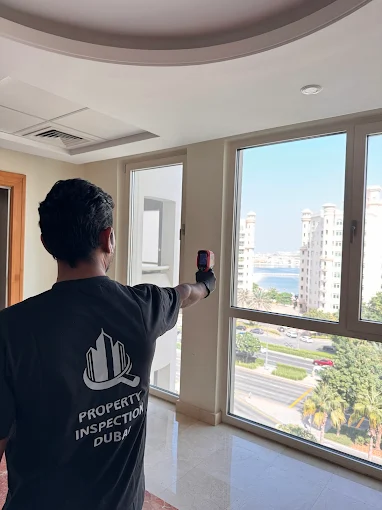
What a Thermal Camera Sees That You Can’t: Inside a Diagnostic Property Inspection in Dubai
Almost every defect that ends up costing a Dubai property owner serious money was present on handover day. It just wasn’t visible.
Water tracking behind a shower wall does not announce itself for months. An AC circuit undersized for a west-facing bedroom performs adequately in February and fails in July. A loose electrical connection in a distribution board runs hot for a year before anything smells wrong. None of these show up in a walkthrough, however carefully you look.
This is the gap a diagnostic property inspection Dubai owners now expect closes. Non-destructive testing tools — thermal cameras, moisture meters, laser levels, acoustic imagers — let an inspector examine what is behind and inside a building without cutting into it. Here is what each one actually does, and what it typically finds.
Why a Visual Walkthrough Misses the Expensive Defects
A home inspection Dubai buyers carry out themselves tends to catch the visible tier: paint coverage, tile alignment, scratched glass, sticking doors. These are worth listing. They are also the cheapest problems in the building.
The costly tier lives in the envelope and the services. Waterproofing membranes sit under screed. Plumbing runs inside walls. Insulation is behind plasterboard. Electrical connections are inside sealed enclosures. Every one of these can be defective while the finished surface in front of it looks perfect.
Instruments are how you get behind the finish without a hammer. That is the entire premise of non-destructive inspection.
Thermal Imaging — Reading Temperature Instead of Colour
A thermal imaging inspection Dubai works on a simple principle: materials at different temperatures emit different amounts of infrared radiation, and wet or poorly insulated materials behave differently from dry, well-insulated ones. Modern sensors resolve differences as fine as a fraction of a degree.
In practice, an infrared camera survey routinely reveals:
- Concealed moisture — damp material holds and releases heat differently to dry material, producing a distinctive plume shape behind an apparently perfect wall
- Insulation voids and thermal bridging — gaps where insulation was cut short or compressed during install, which drive up cooling costs for the life of the building
- Electrical hotspots — connections running abnormally hot inside a distribution board, well before any visible sign of failure
- Underfloor and chilled-water pipe routes and leaks — traced without lifting a single tile
- Air leakage around glazing — poorly sealed window and door perimeters, a significant issue in Dubai’s cooling load
The camera does not diagnose on its own. It tells the inspector where to look harder.
Moisture Meters — Confirming What the Thermal Camera Suspects
A thermal anomaly can have several causes. Moisture detection Dubai inspections use calibrated meters — pin-type and non-invasive — to confirm whether the anomaly is actually water.
This two-step method is what separates evidence from speculation. A report that says “possible dampness observed” is easy for a developer to dismiss. A report that says “moisture content of 24% recorded at 400mm above finished floor level, ensuite east wall, against a dry-reference reading of 8% on the adjacent wall” is not.
Elevated readings in wet areas typically point to one of three causes: a failed or incorrectly lapped waterproofing membrane, poor silicone and grout detailing at floor-wall junctions, or a live plumbing leak. Distinguishing between them determines whether you are looking at a re-seal or a full bathroom strip-out — which is precisely why hidden water leak detection Dubai owners commission is worth doing before a defects liability period expires rather than after.
Waterproofing and MEP consistently rank among the highest-risk defect categories in Dubai handover inspections. They are also the two most likely to be invisible on the day.
HVAC and Electrical — Testing Performance, Not Presence
Confirming that cold air comes out of a vent proves very little. A proper MEP inspection Dubai measures performance under load.
For HVAC, that means recording supply and return temperatures to establish the differential, checking that each zone actually reaches its setpoint, inspecting condensate drainage and fall, and verifying that the FCU is accessible for future maintenance. Improperly installed condensate drains are one of the most common root causes of ceiling staining and mould in Dubai apartments — and the damage appears in a different room from the fault.
If you have searched for why your AC is not cooling properly in a Dubai apartment, the answer is frequently a commissioning defect, not a maintenance one. That distinction matters, because a commissioning defect is the developer’s cost.
For electrical, inspection covers polarity and earthing at every outlet, RCD trip testing, distribution board thermal scanning, and load balancing across circuits. Electrical fault detection Dubai at this level catches installation errors that a socket tester alone will pass.
Beyond the Unit — Façade and Envelope Scanning
For towers, owners associations and commercial assets, building inspection services UAE clients need now extend past individual units. Drone-mounted thermal and LiDAR surveys produce full-envelope coverage of a façade without rope access or scaffolding, mapping water ingress paths, delamination, sealant failure and glazing defects across an entire elevation.
Repeated annually, these scans create a condition baseline — a year-on-year record of how a building is actually degrading. That is increasingly what insurers, facilities teams and asset managers want to see, and it is far cheaper than discovering a systemic façade issue when a panel fails.
Who Actually Needs a Diagnostic Inspection
Not every property needs the full instrument suite. These situations do:
- Pre-handover on a new build — the highest-value moment, while the developer is still liable
- Pre-purchase property inspection Dubai buyers commission on a secondary-market unit, where no warranty exists and the seller has no obligation to disclose
- Resale property inspection Dubai owners run before listing, to fix issues on their own terms rather than under buyer pressure
- Month 9–10 of a defects liability period, before the window closes
- After any water event, where the visible damage is rarely the full extent
A Real Inspection — 4-Bed Villa, Arabian Ranches
A buyer commissioned a villa inspection Dubai on a resale property that had been recently repainted throughout. Visually, it presented as well maintained.
Thermal imaging picked up a cool anomaly running horizontally along the ground-floor guest bathroom wall. Moisture readings confirmed sustained saturation. Behind fresh paint sat an active leak from a first-floor bathroom that had likely been running for months. Separately, distribution board scanning flagged an overheating connection on a kitchen circuit.
Neither was visible. Both were quantified in the report, and both were negotiated into the purchase price before exchange.
Why Choose Property Inspection Dubai
Our inspectors work to international inspection standards and carry the full diagnostic kit as standard — thermal cameras, calibrated moisture meters, laser levels, and electrical test equipment. Findings are compiled into a structured, photographic report with instrument readings against every claim, delivered in a format you can hand directly to a developer, a seller, or a lawyer.
We are certified by DED, RERA-approved and InterNACHI-accredited — providing trusted, precise and professional inspections across Dubai, Abu Dhabi, Sharjah and Ajman.
Against the cost of one undetected leak, a diagnostic inspection is not an expense. It is the cheapest information you will buy in the whole transaction.
Stop inspecting with your eyes. Order a full diagnostic property inspection and find out what is actually behind your walls.
