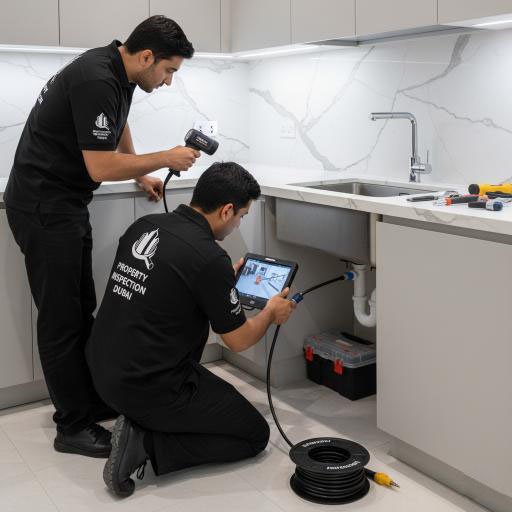
Residential · Post-renovation
Why Kitchen Problems Appear After the Renovation
The cabinets were aligned, the stone looked premium and every appliance worked on handover day. Six weeks later the sink is slow, something smells, and the cabinet base has started to swell.
- Functional testing
- Extraction & drainage diagnosis
- InterNACHI certified
- Report in 24–48 hrs
What a post-renovation kitchen inspection covers
- Sink and appliance drainage under real discharge
- Leak investigation inside and beneath cabinetry
- Cooker hood performance and duct behaviour
- Moisture readings at cabinets, floor and ceiling
- Countertop, sink support and cut-out condition
- Appliance clearances, isolation and access
A kitchen can look excellent and still be technically poor
Owners judge a renovation by what is in front of them: cabinet finish, stone, handles, lighting, appliances, backsplash. All of it matters and none of it says anything about the systems behind the doors.
A kitchen also runs on water supply, drainage, appliance connections, ventilation ductwork, electrical services and maintenance access. Those are installed in the middle of the works, hidden within a day, and only tested properly once the family starts cooking in it — which is why the complaints arrive weeks after the contractor has been paid.
This is the kitchen companion to our guide on hidden bathroom defects that appear months later. The principle is the same: the visible symptom is rarely where the defect is.
If a drain smells, do not assume it needs cleaning. If a cabinet is swelling, do not replace it before finding the leak. If the hood is weak, do not replace the motor before checking the duct. If the dishwasher will not drain, do not replace the appliance before looking at the hose behind it.
First distinction
Is the smell coming from the drain or the duct?
Kitchen odour is the most misdiagnosed complaint we attend, because two unrelated systems produce it and both are invisible. What the owner notices about the timing narrows it faster than any tool does.
- Points to drainage — appears after the sink or dishwasher discharges
- Strongest at the cabinet — worse with the sink unit door open
- Returns after cleaning — the drain clears, the smell comes back within days
- Comes with symptoms — slow drainage, gurgling, repeat blockages
- Likely causes — trap problem, unsealed waste connection, open drainage connection, backfall holding stagnant water
- Points to extraction — present when the hood is off, clears when it runs
- Not your cooking — arrives at mealtimes that are not yours
- Air movement — noticeable draught at the hood when it is switched off
- Comes with marks — grease or dirt around the hood, ceiling or cabinet tops
- Likely causes — leaking duct joint, missing or stuck backdraft damper, incorrect riser connection, duct discharging into a ceiling void
Drainage
Why the sink starts draining slowly in a brand-new kitchen
A kitchen waste carries water, food residue, grease and cleaning chemicals with nothing but gravity behind it. Geometry decided behind a cabinet governs whether it copes — and cleaning the pipe treats the consequence, not the cause.
Wall outlet set too high
If the drainage connection in the wall sits above where the sink waste naturally arrives, the installer has to improvise a route that climbs before it falls.
Shows as: permanently slow drainage from the day the kitchen was finished.
Backfall in the waste run
A section sloping the wrong way holds wastewater permanently, and grease and food deposits build in the standing water rather than passing through.
Shows as: smell, gurgling and blockages that return every few weeks.
Flexible waste creating low points
Flexible hose used because it was easier to fit sags between its supports, and each sag becomes a trap the system never designed.
Shows as: deposits, difficult cleaning, recurring slow flow.
Awkward trap arrangement
Extra fittings added to make an ill-positioned connection work introduce restrictions and joints under stress.
Shows as: gurgling, and leaks that appear months later at the joints.
Double bowl sharing badly
Where two bowls meet one waste through a poorly arranged tee, discharge from one bowl finds the other easier than the drain.
Shows as: water rising in the second bowl, slow clearing in both.
Construction debris left in the line
Grout, sealant offcuts and packaging find their way into an open pipe during a renovation and settle at the first restriction.
Shows as: blockages within weeks of a kitchen being finished.
Appliances
Why the dishwasher gets blamed for the installation
Most appliance complaints we investigate after a renovation are not appliance faults. They are about the hose behind the machine, the valve beside it, or the connection it discharges into.
- Kinked or crushed drain hose — created when the machine was pushed back into its opening
- Improvised drain arrangement — anti-backflow detail decided on site rather than from the instructions
- Poor waste connection — appliance discharge meeting resistance at the tee
- Dirty water returning — a drainage arrangement problem, not a dirty machine
- Unsecured washing-machine hose — works loose and floods the run
- Water filters and RO systems — housing, tubing, tank and drain connection all add leak points inside the cabinet
- Under-sink water heaters — connections, mounting and safety components worth inspecting where fitted
- Fridge water lines — pinched when the appliance was pushed home
- Isolation valves — buried behind fixed joinery, leaving only the property’s main
- Appliance sockets — trapped behind the machine they serve
Hot and cold supplies, mixer hoses, isolation valves, the sink waste, the dishwasher supply and waste, often a filter and an electrical point — inside one box with a door that stays shut. Leaks there are found by swollen board and a damp smell, not by seeing water, which is why inspection happens with everything running rather than dry.
Hidden water
Why cabinets swell and floors stay wet underneath
Water under fixed base units can run for months before anything shows, because the space is sealed, unlit and never opened. By the time the symptom is visible, the material has already absorbed it.
- Possible sources — sink waste or supply, dishwasher, washing machine, fridge water line, filter system, floor drainage
- Sink edge leakage — failed sealant or a gap at the cut-out letting water into the carcass below
- Sink movement — an undermount losing its support, opening the seal
- Water against the backsplash — a countertop that is not level, stressing the sealant line
- Condensation — cold surfaces and poor airflow inside a closed cabinet
- First visible signs — swollen kickboards, raised edges, soft board, peeling laminate, a musty smell
- Floor drain that never receives water — set higher than the surrounding floor, so a leak travels elsewhere
- Leaks that appear only sometimes — when the sink is full, during dishwasher discharge, on hot water, or when the tap is moved
- Ceiling staining — plumbing, AC condensation, the unit above, or a roof penetration in a villa
- What not to do — repaint the stain or replace the cabinet before the source is known
Extraction
Why a powerful hood still leaves the smell in the room
The fan is one part of the system. The duct above it is the rest, and it was routed through whatever space was left after the ceiling services went in.
Undersized or reduced duct
Narrowed to pass an obstruction, the duct restricts airflow permanently. The hood sounds strong because it is working against resistance.
Too many bends, crushed runs
Tight turns, long flexible sections, sagging and duct squeezed between services all add resistance that no fan setting recovers.
Discharging into the ceiling void
Greasy, humid air released into a closed space accumulates deposits, odour and moisture, and attracts pests — while extraction performance stays poor.
Backflow through the hood
A damper issue, an incorrect riser connection or pressure differences in a shared ventilation system can send air and odour the wrong way.
Recirculating, not ducted
Some hoods run either way. A hood over the hob is not proof that air leaves the property, and filters in recirculation mode need servicing to work at all.
Noise instead of performance
Excessive noise usually means restriction, a loose duct, vibration against cabinetry or a rattling damper — not a defective motor.
Where the duct terminates through the roof, the penetration is a new opening in the waterproofing. Poor flashing, failed sealant, an incorrect cap or unsupported duct can let water into the roof assembly — so the hood extracts perfectly and the ceiling stains in the first heavy rain.
Stone, layout and access
The defects that only appear once you live with the kitchen
Some post-renovation complaints are not failures at all. They are decisions — made on a drawing, discovered in use.
- Cracks at a cut-out corner — weak sections, sharp corners, poor support or movement beneath the sink
- Undermount sink going loose — carried by adhesive rather than brackets, under the weight of water and cookware
- Long unsupported overhang — movement or cracking where stone projects for seating
- Countertop holding water at the wall — not level, or a local dip stressing the sealant joint
- Fridge doors that open but not enough — set too close to a wall, so drawers cannot be removed
- Doors and appliances colliding — dishwasher against the island, oven against opposite units, corner doors against drawers
- Built-in ovens overheating cabinetry — blocked ventilation path or an opening tighter than the manufacturer allows
- Appliances that cannot be serviced — permanently fixed kickboards, valves behind panels, plugs out of reach
Diagnostic reference
Symptom to possible cause
A starting point for investigation, not a conclusion. One symptom can have several causes, and one cause often produces several symptoms.
- Slow sink drainage — insufficient fall, wall outlet set too high, low points in a flexible waste, partial blockage
- Drain smell that returns — trap problem, unsealed waste connection, open drainage connection, stagnant water in a flat run
- Cooking smell that lingers — restricted or leaking duct, wrong hood height, recirculation mode, filters needing service
- Air returning through the hood — damper issue, incorrect riser connection, shared ventilation behaviour
- Dishwasher not draining — kinked or crushed hose, improvised drain arrangement, blockage in the branch
- Dirty water returning to the appliance — backflow from a poor connection height or arrangement
- Water inside the sink cabinet — mixer hoses, valves, trap, sink seal, appliance connection or filter system
- Swollen cabinet or kickboard — slow leak, sink edge leakage, appliance leak, or water tracking under the units
- Repeated blockages — poor slope, restriction, bad connection, or construction debris in the line
- Cracked stone at a cut-out — weak section, poor support beneath, or movement in the base units
- Ceiling stain — plumbing, AC condensation, leakage from above, or a roof penetration in a villa
- Sockets or plugs becoming warm — loading, connection quality or accessory condition, for a qualified electrician to assess
Method
How a kitchen defect should be investigated
Pulling out an appliance or opening a ceiling is the last step. A structured investigation eliminates possibilities in order of cost, so that if something does have to come apart, it is the right thing.
-
Record the history
What was changed, when the symptom started, what makes it worse, and what has already been repaired. Photographs taken before the cabinets went in are worth more than anything else the owner has.
-
Open the cabinets before touching anything
The sink unit, the units either side, the kickboard line. Moisture readings and a look at board edges establish whether water is involved at all.
-
Test each outlet and appliance separately
Cold, then hot, then a full sink discharge, then the dishwasher through a drain cycle — with the cabinet watched throughout rather than checked afterwards.
-
Run the extraction through its range
Every speed, checking capture, noise, vibration, leakage at the hood connection and whether anything returns when it is switched off.
-
Look above the ceiling where access allows
Duct route and joints, drainage, water lines and AC services through existing access panels, with thermal patterns used to target where to look.
-
Then pull an appliance or open a panel
By that stage the investigation is targeted. That is the difference between a diagnosis and a demolition.
Clearing the drain, replacing the sealant, drying the cabinet or painting over a ceiling stain all remove the evidence that would have identified the cause. Leave it as it is and note when the problem appears.
Timing
When a kitchen inspection is worth arranging
- The renovation has just finished and the final payment is still pending
- A smell has appeared at the sink or through the hood
- Drainage has slowed or blockages keep returning
- The dishwasher is not draining or returns dirty water
- Cabinet swelling or a damp smell has started
- Extraction is weak or air comes back through the hood
- Water or staining has appeared under units or on the ceiling
- You are buying a property with a recently renovated kitchen
Premium materials do not make a good kitchen
A kitchen can contain imported stone, high-end cabinetry and German appliances and still have poor drainage falls, a strangled duct, an inaccessible isolation valve and a leak behind the dishwasher. Material quality and workmanship are separate things, and only one of them is visible on handover day.
That is also why post-renovation complaints get misread so often. The smell is at the sink but the cause is in the duct. The cabinet is swollen but the water came from the appliance next to it. The hood is weak but the fan is fine. The place the symptom appears is rarely the place the defect is.
The value of an independent inspection here is the independence. We inspect and diagnose. We do not carry out kitchen work, hold no interest in the remedial contract and quote for none of it — so the finding is a finding rather than an opening bid.
Related services
Inspections booked alongside this one
Questions
Post-renovation kitchen FAQs
Why did my kitchen problems only start weeks after the renovation?
Is the smell coming from the drain or the cooker hood?
Why does my new dishwasher not drain properly?
Why is my expensive cooker hood not clearing steam and smells?
My kitchen cabinet is swelling. Should I just replace it?
The drain was cleared and the smell came back. Why?
Can you find a leak without pulling the kitchen apart?
Can you inspect the hood duct after the ceiling is closed?
Is a crack near the sink or hob cut-out serious?
My fridge fits but the drawers will not come out. Is that a defect?
What should I do before the inspection?
Can the report be used with my contractor or in a claim?
Do you carry out the repairs you identify?
Find the cause first. Repair the right defect once.
If your renovated kitchen is smelling, leaking, draining slowly or failing to extract, a post-renovation inspection establishes what is actually happening before more money goes into fixing the wrong thing.
