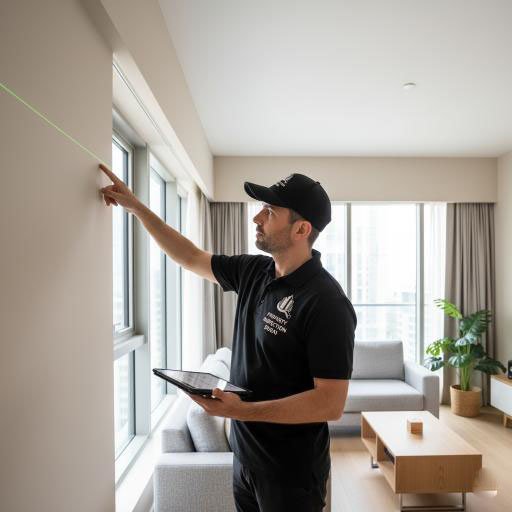
In Dubai’s renovation and fitout market, the final payment to a contractor is often 10% to 20% of the total contract value — a sum that can range from a few thousand dirhams for a bathroom refit to hundreds of thousands for a full villa renovation or commercial fitout. That final payment is the only real leverage a property owner holds once the work is complete. Once it is released, the contractor’s incentive to return and fix outstanding defects drops sharply.
This is the problem that independent fitout snagging inspections are designed to solve. Before you sign off on a contractor’s work and release that final payment, a certified inspector walks the completed fitout systematically, documents every defect with photographic evidence, and produces a formal defect report that you present to the contractor as a condition of payment. The contractor fixes everything on the list. Then — and only then — the payment is released.
This guide explains the process, what our inspectors look for, and how to use the inspection report to protect your position.
Why You Need an Independent Inspector — Not Your Own Eyes
Most property owners walk through a completed renovation and see what they expect to see: fresh tiles, new fittings, clean paintwork. The human eye in normal lighting conditions, without systematic methodology, misses the majority of workmanship defects that an inspector will find. This is not a criticism — it is simply the reality of how inspection works.
Hollow floor tiles cannot be identified visually. They must be found by sounding. Waterproofing failures behind bathroom tiles are invisible until moisture has penetrated deep enough to stain or damage an adjacent surface — typically six to eighteen months after completion. Tile lippage — height differences between adjacent tile faces — requires a straight edge and measurement to quantify. Cabinet door misalignment of 2–3mm looks approximately right but fails the standard. Plumbing joint weeps at low pressure are invisible without running water and waiting.
A certified inspector brings methodology, calibrated tools, and a systematic checklist that covers every trade in the fitout. They find what you would miss. And crucially, they produce a written, photographic report that gives you a professional document to present to your contractor — not a verbal conversation you have to defend.
When to Book the Inspection
Timing is critical. The inspection should be booked when the contractor declares the work practically complete — all trades finished, all fittings installed, all surfaces cleaned down — but before you have done any formal sign-off or indicated acceptance of the work.
Do not inspect during active construction. Do not inspect with punch items still outstanding. The inspection is most valuable when the contractor believes the job is done and is expecting final payment. This is precisely the moment when an independent assessment carries the most weight.
If the contractor has been working in stages — for example, kitchen first, then bathrooms — you can request a stage inspection after each phase, which prevents defects from earlier phases being concealed by later works.
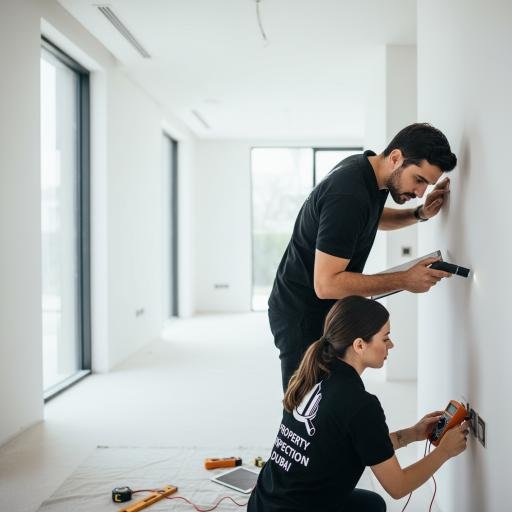
What Our Inspectors Check: The Full Fitout Scope
Wet Rooms — Bathrooms and Kitchens
Wet rooms receive the most detailed attention in any fitout inspection because they are the highest risk area for both workmanship failure and long-term consequential damage.
Waterproofing integrity is assessed using Protimeter moisture meters on all tiled wall and floor surfaces. We scan systematically across the shower zone, wet floor area, and all wall surfaces within 500mm of water outlets. Any reading above baseline triggers further investigation with FLIR thermal imaging to identify whether the moisture signature indicates active ingress behind the tile membrane.
Tile installation is assessed for lippage between adjacent faces (acceptable tolerance ±2mm rectified, ±3mm non-rectified), hollow tiles by sounding every tile in the wet zone and floor area, grout joint consistency and depth, and correct application of flexible sealant — not grout — at all movement joints including floor-to-wall junctions, internal corners, and around sanitary fixtures.
Plumbing connections are tested by running all outlets and waste systems under flow conditions. We check all supply connections for weeping at joints, all waste outlets for correct trap depth and adequate drainage speed, and all hot and cold supplies for correct isolation valve function.
Sanitaryware is checked for level installation, secure substrate fixing, correct seal at wall and floor junctions, and absence of movement under manual load.
Floors Throughout
All floor finishes — tile, wood, laminate, vinyl, or screed — are inspected for correct installation across the full area. Tile floors receive hollow tile testing and lippage measurement as standard. Timber and laminate floors are checked for secure fixing, absence of bounce or movement underfoot, correct expansion gap at perimeters, and clean threshold transition strips. Screed floors are checked for surface level tolerance and crack formation.
Walls and Ceilings
All newly plastered or boarded walls are checked for surface straightness using a 2m straight edge, hollow spots by sounding, and correct joint finishing at ceiling and floor junctions. Gypsum board installations are checked for screw pattern, tape and joint finish, and adequacy of fixing into the substrate framing. Paint finish is assessed under raking light for roller marks, lap lines, missed edge cuts, and uneven sheen — the same methodology used in our standard snagging inspections.
All ceiling installations — flat plaster, gypsum board, suspended grid, or feature elements — are checked for level, secure fixing, correct junction detail at walls, and absence of visible deflection between fixing points.
Joinery and Cabinetry
Every installed cabinet, wardrobe, vanity unit, and kitchen run is inspected for level installation, secure fixing into the wall substrate, door and drawer alignment, hinge and runner function, and worktop seam quality. Door face gaps across a run of units are measured — consistency to within ±1mm is the standard. Soft-close mechanisms are tested on all applicable doors and drawers.
Built-in wardrobes and storage units are checked for correct internal fit, secure hanging rail fixing, and correct door clearance at floor and ceiling junctions.
Electrical and Lighting
All new electrical work is tested at socket and switch level — every outlet is tested with a socket tester for correct wiring polarity and earthing, every switch is operated, and every lighting point is tested for correct function. DB board labelling is verified against actual circuits. Any new circuit additions are checked for correct MCB rating and RCD protection where required.
Doors, Frames and Hardware
All new or relocated door frames are checked for plumb and square installation, correct reveal dimensions, and absence of twist. Every door is tested for correct hang, adequate swing clearance, latch engagement, and lock function. All hardware — handles, hinges, closers, and locks — is operated and checked for secure fixing and correct adjustment.
How to Use the Inspection Report
Once the inspection is complete, our Spectora report is delivered within 24–48 hours, organised by trade category with photographs, precise location descriptions, and defect classification by severity.
You present this report to your contractor formally, in writing, as a condition of final payment. The report establishes clearly what is outstanding, provides photographic evidence that cannot be disputed, and creates a written record that protects your legal position if the contractor refuses to remediate.
Most contractors respond constructively to a professional inspection report — it removes ambiguity and gives them a clear, workable list. For contractors who are resistant, the report provides the documented basis for withholding payment or pursuing a contractual claim.
After remediation is complete, a re-inspection can be booked to verify that all listed defects have been correctly addressed before the final payment is released.
Certified Inspection You Can Rely On
Property Inspection Dubai is InterNACHI-certified, with 44,000+ properties inspected across the UAE. Our inspectors use professional tools — FLIR thermal cameras, Protimeter moisture meters, socket testers, digital levels, and tile lippage gauges — and report through Spectora software, producing a clear, photographic, trade-categorised defect report.
Book Your Pre-Payment Fitout Inspection Today
Your contractor is expecting final payment. Make sure the work is worth it first.
📞 Call or WhatsApp: +971 56 378 7002
🌐 www.propertyinspectiondubai.ae
📧 info@propertyinspectiondubai.ae
Reports delivered within 6 hours. Covering Dubai, Abu Dhabi, and Sharjah.
