How Property Inspection Tools Work: Thermal Cameras, Moisture Meters & Testing Equipment Explained
Walk alongside a professional inspector for an hour and you’ll notice something: they trust their instruments more than their eyes. Not because their eyes are bad after enough properties, an inspector’s eye is remarkably sharp — but because eyes report opinions, and instruments report numbers.
This guide explains how the core property inspection tools actually work: what’s happening inside the device, what the readings mean, and which defects each one exposes. Whether you’re about to book an inspection in Dubai or you’re simply curious what all that equipment does in your new home, this is the technology explained in plain language.
Thermal Imaging: Reading Heat Instead of Light
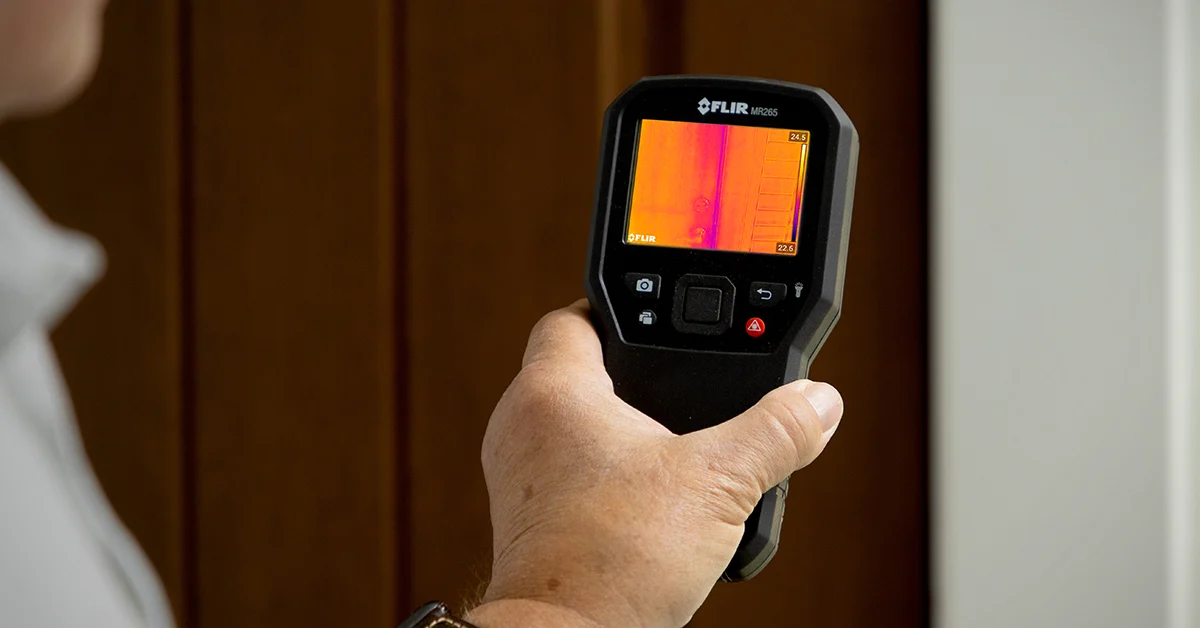
A thermal camera doesn’t see through walls — that’s the most common misconception. What an infrared thermal imaging inspection actually does is measure the infrared radiation coming off surfaces and convert those temperature differences into a colour picture.
Why is that useful? Because building defects change surface temperature in predictable ways:
- Moisture cools. Water evaporating from a damp patch pulls heat from the surface, so a leak behind tiles shows up as a cold (usually blue or purple) zone often days or weeks before any visible stain appears.
- Missing insulation warms or cools. In a Dubai summer, a wall section without insulation lets exterior heat straight through, glowing warm on the scan while the insulated areas around it stay cool.
- Electrical faults heat up. A loose connection has higher resistance, and higher resistance means heat. A single breaker running hotter than its neighbours inside a distribution board is a fault announcing itself.
Reading the image takes training. A cold spot might be moisture or it might be an AC duct behind the wall doing exactly its job. This is why professional thermographers scan methodically, compare symmetrical areas, and confirm every suspicious reading with a second instrument before calling it a defect.
Moisture Meters: Turning “Feels Damp” Into a Percentage
If thermal imaging raises the suspicion, moisture meter testing delivers the verdict. Two technologies do the work:
Pin-type meters push two small electrodes into the material and measure electrical resistance between them. Water conducts electricity; dry plaster doesn’t. The wetter the material, the easier current flows, and the higher the reading.
Pinless (capacitance) meters press flat against the surface and send an electromagnetic field up to around 20–40mm deep, detecting moisture without leaving marks essential for finished walls, wooden floors, and anywhere a client would rather not see pinholes.
What the numbers mean: every material has a normal moisture range. Gypsum plaster sitting above roughly 1% needs explaining. Wood flooring above 12–14% is at risk of cupping and warping. A concrete screed that reads wet should never be tiled or covered until it dries doing so traps the moisture and guarantees adhesive failure, debonding, or mould later.
The meter’s real value is comparison. One reading means little; a grid of readings across a wall shows exactly where moisture starts, peaks, and ends which usually points straight at the source.
Acoustic Tile Testing: The Physics of the Hollow Sound
The simplest technology on this list is pure physics. When an inspector taps a properly bonded tile, the sound energy travels through the tile, through the adhesive, into the substrate — producing a short, solid note. Tap a tile with a void beneath it and the sound has nowhere to go; the tile vibrates like a tiny drumhead, producing a longer, hollower tone.
That hollow note matters because a void means the adhesive never fully supported the tile. Under Dubai’s temperature swings and normal furniture loads, unsupported tiles crack, lift at the corners, or debond completely. A systematic tap survey every tile, floor and wall maps these weak points while they’re still a rectification item rather than a broken floor.
It’s also the perfect example of why home inspection technology isn’t always electronic. The tool is simple; the discipline of testing every single tile, and knowing a genuine void from an acceptable edge sound, is what you’re paying for.
Electrical Testers: Proving Safety Instead of Assuming It
Electrical testing answers questions that sight never can. Three instruments do the heavy lifting during an electrical safety inspection:
Socket testers plug into each outlet and instantly check that live, neutral, and earth are connected — and connected in the right order. Reversed polarity or a missing earth looks identical to a perfect socket from the outside.
RCD testers deliberately create a tiny, controlled fault to measure how fast your residual current device disconnects the power. The safety standard is milliseconds around 300ms maximum for a standard 30mA RCD, and much faster at higher test currents. A breaker that trips too slowly, or not at all, offers no real protection at the moment someone touches a live fault.
Earth continuity checks confirm the protective path from your socket back to the earthing system is genuinely continuous. We regularly find new units in Dubai where individual circuits often in bathrooms, the worst possible place have no working earth.
None of these results are visible in a walkthrough. All of them are pass/fail numbers in a proper inspection report.
Laser Measurement: Millimetres Don’t Lie
A line laser projects a perfectly straight, perfectly level reference across a room and everything the builder did is compared against it. Digital inclinometers do the same job for individual surfaces, reading slope in fractions of a degree.
The applications are everywhere: floor levels across a living room, fall direction in showers and on balconies (water must run toward the drain you’d be surprised), the straightness of ceiling bulkheads, the plumb of walls and doorframes. Recording the deviation in millimetres transforms a vague complaint (“this floor feels uneven”) into an objective defect with a number attached the kind a developer’s rectification team actually acts on.
What These Tools Can’t Do
An honest inspection company tells you the limits, so here they are:
- No tool sees through concrete. Thermal cameras read surfaces; moisture meters read a few centimetres deep. Defects buried in the middle of a slab need invasive testing that’s outside a standard inspection.
- Instruments detect anomalies, not causes. A cold, damp patch is a fact; whether it’s a pipe leak, a waterproofing failure, or condensation takes investigation and experience to determine.
- Conditions matter. Thermal imaging works best with a temperature difference across the building envelope; moisture readings shift with recent cleaning or humidity. Professionals plan around this — a gadget owner usually doesn’t.
That last point is really the theme of this whole guide. The equipment is available to anyone. The interpretation knowing which readings matter, which are noise, and how to document them so they get fixed is what a professional property inspection in Dubai actually delivers.
Instruments Plus Experience: How We Inspect
At Property Inspection Dubai, every inspection combines the full instrument set described above with engineers who have read these tools across thousands of properties apartments, villas, and commercial units throughout the city. Every anomaly is verified with a second method, photographed, located on a plan, and written into a clear report you can hand directly to your developer or contractor.
Booking an inspection, or want your recent handover double-checked? Contact Property Inspection Dubai today and get findings measured in numbers, not opinions.
