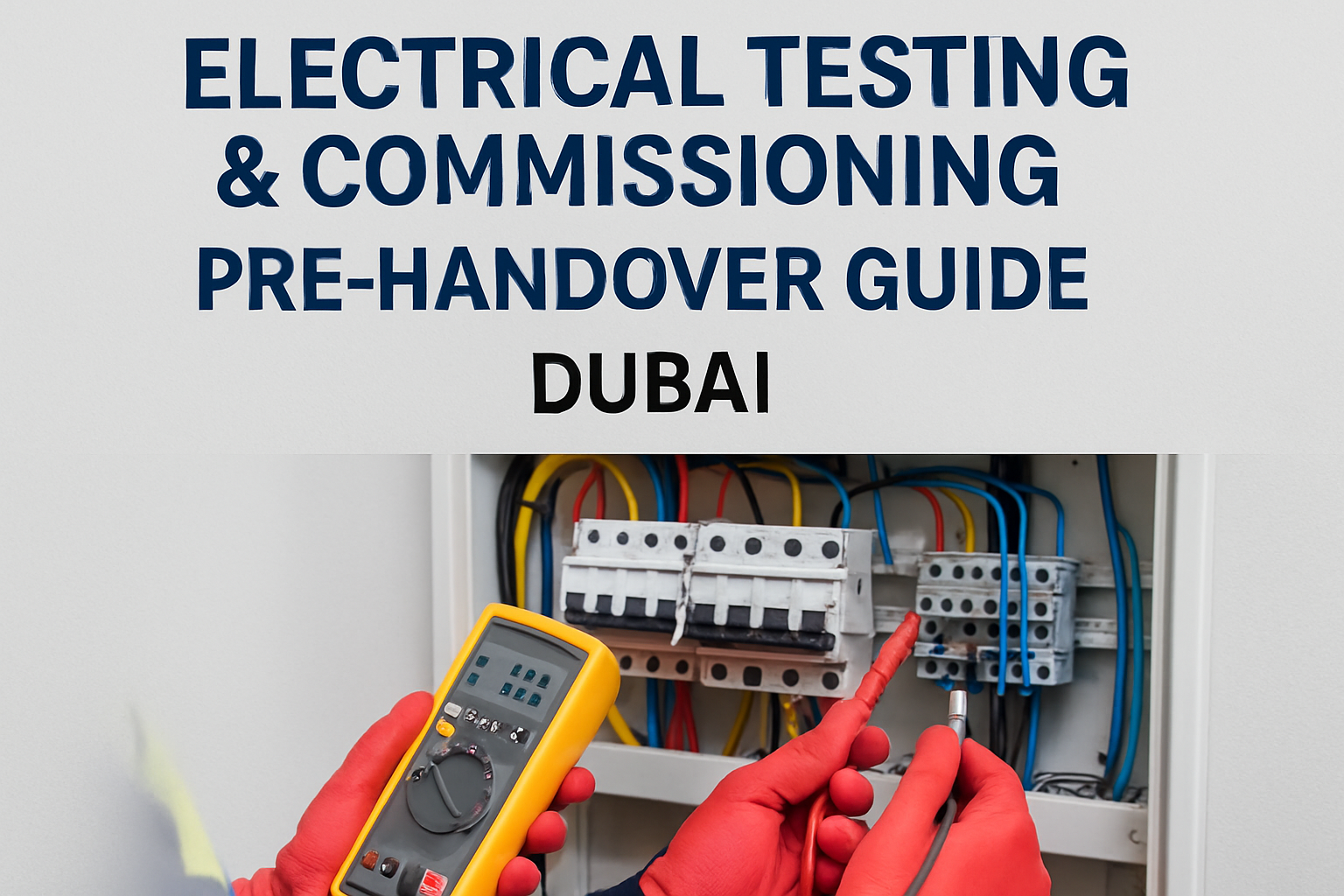
When you’re about to take possession of a new villa, apartment, or commercial unit in Dubai, a visual inspection might tell you that everything looks perfect. But beneath the fresh paint, modern fixtures, and sleek finishes, your electrical system could be hiding critical faults that won’t surface until months or years after handover—when it’s too late to claim warranty coverage.
Electrical testing and commissioning is the professional process that identifies these hidden hazards before you accept the keys. At Property Inspection Dubai, we’ve inspected thousands of properties and found that 1 in 3 new builds have undetected electrical defects. Many of these defects cost homeowners 5,000–50,000 AED to repair after handover. This guide explains everything you need to know about electrical testing and commissioning in Dubai.
Why Electrical Testing and Commissioning Matters Before Handover
Your electrical system powers everything in your home—lighting, cooling, heating, safety systems, and appliances. A faulty circuit breaker, loose wiring connection, or overloaded panel doesn’t just compromise convenience; it creates fire hazards, electrical shocks, and system failures.
Common Electrical Defects Found During Inspections:
- Loose connections in distribution boards – Create resistance and extreme heat
- Faulty circuit breakers – Don’t trip when they should, allowing overcurrent
- Poor earthing and grounding – Creates shock hazards and equipment damage
- Overloaded circuits – Exceed capacity, causing system shutdowns
- Damaged or missing insulation – Exposes live wires
- Incorrect wiring polarity – Energizes neutral or earth conductors
- Thermal hotspots – Invisible to the naked eye but detectable via thermal imaging
The Financial & Safety Impact:
One electrical fault can result in:
- Fire damage to your entire property
- Electrical injuries to family members
- Equipment failures costing 10,000–50,000 AED to replace
- Insurance claim denials if defects were pre-existing
- No developer liability once you’ve signed handover documents
This is why professional electrical testing and commissioning before handover is non-negotiable.
Understanding Electrical Testing and Commissioning Standards in Dubai
In Dubai, all electrical installations must comply with DEWA (Dubai Electricity and Water Authority) regulations. DEWA’s mandate is to ensure every electrical system in the emirate operates safely and efficiently.
What DEWA Requires:
Electrical testing and commissioning must verify:
- Proper circuit protection (MCBs, RCDs)
- Correct voltage levels (220V ±10%)
- Proper earthing and grounding continuity
- Cable sizing appropriate for load
- Compliance with DEWA’s 2025 Electrical Installation Regulations
- Safe disconnection means for all circuits
The Commissioning Process:
Electrical commissioning is the formal certification that every system is ready for occupancy. It involves:
- Visual inspection of all panels, circuits, and connections
- Polarity testing – Confirms earth, neutral, and live wires are correctly installed
- Insulation resistance testing – Ensures no current leakage between conductors
- Earth continuity testing – Verifies grounding safety
- Load distribution analysis – Confirms circuits aren’t overloaded
- Safety device verification – Tests RCDs and MCBs for proper function
- Thermal imaging scan – Detects overheating components (see section below)
- DEWA compliance verification – Ensures the system meets all regulations
After commissioning, your property receives a Certificate of Compliance from DEWA. However, this certificate doesn’t guarantee the system will work flawlessly for you—it only confirms regulatory compliance. That’s where professional electrical testing comes in.
What’s Tested During Electrical Testing and Commissioning
Professional electrical testing and commissioning covers far more than DEWA’s compliance checklist. Here’s the complete scope:
Distribution Board & Main Panel
- Panel condition, labeling, and accessibility
- Breaker functionality and correct amperage ratings
- Bus bar integrity and no visible corrosion
- Proper bonding of all conductors
- No signs of heat or overload
All Circuits & Sub-Circuits
- Each circuit tested individually for proper function
- Load distribution verified across all phases
- No circuits overloaded beyond their rating
- Spare capacity confirmed for future expansion
Every Outlet, Switch & Fixture
- Polarity tested at each socket (earth, neutral, live confirmed)
- Ground continuity verified
- All switches functioning correctly
- Light fixtures properly earthed
- No loose connections at terminals
Electrical Cables & Wiring
- Cable routing and protection examined
- Insulation integrity confirmed
- Proper color coding throughout
- No damaged or pinched wires
- Correct sizing for circuit amperage
Safety Devices
- RCDs (Residual Current Devices) tested for proper trip response
- MCBs (Miniature Circuit Breakers) tested for sensitivity
- GFCI outlets in wet areas function correctly
- Emergency shutdown accessible and labeled
Thermal Imaging Reveals Hidden Electrical Defects
One of the most powerful tools in electrical testing and commissioning is thermal imaging. While standard testing verifies function, thermal cameras detect electrical faults that would otherwise go unnoticed for years.
How Thermal Imaging Works:
Electrical connections generate heat due to resistance. Normal, healthy connections produce minimal, uniform heat. But loose connections, corroded terminals, and overloaded circuits create significant heat that thermal cameras detect as “hot spots.”
What Thermal Imaging Reveals:
- Loose breaker connections – Appear as bright red or orange on thermal images
- Corroded terminals – Show as localized overheating
- Load imbalances – One phase running hotter than others
- Faulty circuit breakers – Show irregular heat patterns
- Overheating cables – Indicate insufficient insulation or overload
- Thermal bridging – Heat escaping through poor insulation
Real Impact:
A single loose breaker connection discovered via thermal imaging can prevent an electrical fire and save 25,000+ AED in potential damage. This is why thermal imaging is now standard in professional electrical testing and commissioning services.
Property Inspection Dubai’s Electrical Testing Approach
At Property Inspection Dubai, our electrical testing and commissioning service goes beyond regulatory compliance. We inspect for functional safety, long-term reliability, and future-proofing.
Our Process:
Step 1: Pre-Inspection Coordination
- We coordinate with your developer to schedule testing
- We confirm all utilities (DEWA, AC, gas) are active for proper testing
- We review your property’s electrical plans
Step 2: Comprehensive Testing
- Every electrical component is tested individually
- Thermal imaging scans all panels and connections
- We document findings with high-resolution photographs
Step 3: Detailed Analysis
- Results are evaluated against DEWA standards and international best practices
- Defects are prioritized by severity (critical, major, minor)
- Repair recommendations are provided
Step 4: Professional Reporting
- Developer-ready report delivered within 24–48 hours
- Clear photos with annotations showing defect locations
- Actionable recommendations for each issue
Why Choose Property Inspection Dubai:
✓ Certified professionals – Our engineers are trained to international standards
✓ Advanced equipment – Thermal cameras, multimeters, and specialized testing tools
✓ Thermal imaging included – Standard in every electrical inspection (not extra cost)
✓ Fast turnaround – Reports delivered within 24–48 hours
✓ Developer coordination – We negotiate directly with developers on your behalf
✓ De-snagging support – We re-inspect after repairs to confirm fixes
How to Prepare for Electrical Testing and Commissioning
Before booking your inspection:
- Ensure DEWA is connected – Electricity must be active for proper testing
- Confirm utilities are on – AC, gas, and water should be connected
- Allow developer access – We’ll coordinate directly with them
- Provide property access – All rooms, closets, and mechanical spaces must be accessible
- Schedule well before handover – Book 5–7 days before your official handover date
Book Your Electrical Testing & Commissioning Inspection
Your electrical system is your home’s lifeline. Professional electrical testing and commissioning before handover is the single most important step to protect your investment and your family’s safety.
