Why Your New Villa Smells Damp — The Real Cause Behind Moisture Problems in Dubai Properties
You collected your keys a few weeks ago. The villa looked immaculate at handover — clean finishes, fresh paint, every fitting in place. But now there is a smell. It is subtle at first, but persistent. A musty, damp odour that clings to certain rooms, comes and goes with the AC, and will not go away no matter how many times you open the windows.
You are not imagining it. And it is not going to resolve on its own.
A damp smell in a new Dubai villa is one of the most common post-handover complaints — and one of the most misunderstood. Most owners assume it is residual construction smell or humidity trapped during the build. In reality, it almost always points to an active moisture problem inside the property that needs to be found, documented, and fixed before it causes serious structural and health-related damage.
This guide explains the real causes of moisture problems in Dubai properties, why Dubai’s climate makes them worse, and what a professional property inspection can do to locate the source before the damage becomes irreversible.
That Damp Smell Is Not Normal — Even in Dubai
There is a common misconception that dampness is just part of living in the Gulf. Dubai is humid, temperatures are extreme, and buildings work hard. Some moisture is inevitable — so the thinking goes.
This is incorrect. A well-built, properly waterproofed, and correctly ventilated property in Dubai should not smell damp. When it does, the smell is not an environmental condition — it is a symptom. It means moisture is present somewhere inside your structure in a quantity sufficient to begin breaking down organic materials, promoting microbial growth, or saturating building substrates.
Why New Properties Are Not Immune
First-time villa owners are often surprised that a brand-new property develops moisture issues so quickly. The reality is that new builds are particularly vulnerable during the first 12 to 24 months. Construction moisture trapped in concrete, screed, and plaster needs to fully cure and evaporate. Waterproofing membranes applied under time pressure may have gaps, pinholes, or failed laps. Sealants applied in the rush to reach handover may not have been given adequate cure time.
By the time you move in and start running your AC system continuously, the conditions are set for moisture problems in Dubai villas to surface — and the smell is usually the first sign.
The Five Real Causes of Moisture Problems in Dubai Villas
Understanding where the moisture is coming from is the only way to fix it permanently. Here are the five most common root causes found during property inspections in Dubai.
1. Failed Waterproofing Membranes
The single most frequent cause of serious damp problems in Dubai villas is waterproofing failure. Every wet room — bathrooms, kitchen, utility areas — requires a continuous, sealed waterproofing membrane beneath the tiles and screed. Balconies, roof terraces, and podium slabs require heavy-duty external membranes.
When these membranes fail — due to poor installation, material defects, shrinkage cracking, or incomplete coverage — water migrates through the substrate and spreads laterally through the structure. By the time the damp smell appears, the moisture may already be two or three metres from the original failure point. The smell is real; the source is hidden.
2. AC Condensate Leaks and Drainage Failures
Dubai’s AC systems run almost continuously. Every unit produces significant condensate water as part of the cooling cycle — water that must drain away through correctly installed condensate pipes. When these pipes are installed at the wrong gradient, become blocked, or have joint failures, condensate water backs up and pools inside ceiling voids, wall cavities, and duct housings.
AC condensate leaks are responsible for a large proportion of the damp smell complaints we investigate in new Dubai villas. The water accumulates slowly and invisibly, saturating insulation and ceiling substrates before any visible staining appears. The smell — musty, cold, and mechanical — is distinctive once you know what you are looking for.
3. Plumbing Pipe Sweating and Joint Failures
In Dubai’s climate, cold water supply pipes running through warm wall cavities produce significant condensation on their outer surfaces — a phenomenon known as pipe sweating. Over time, this moisture saturates the surrounding insulation and masonry. Combined with any minor joint seepage from incorrectly assembled or under-torqued fittings, the cumulative moisture loading inside wall cavities can become substantial.
Damp walls in Dubai apartments and villas traced to plumbing routes are a consistent finding across both new and resale properties. Thermal imaging identifies the pipe runs and any anomalous cold patches that indicate active sweating or leakage.
4. Inadequate Vapour Barriers in Walls
External walls in Dubai face extreme thermal differentials — scorching heat on the outside, heavily cooled air on the inside. Without a correctly installed vapour barrier within the wall build-up, warm humid air migrating inward hits the cold interior surface and condenses. This condensation inside walls builds up over time within the insulation layer and wall substrate, producing exactly the kind of persistent damp smell that does not respond to ventilation because the source is structural.
This is a design and construction defect, not a maintenance issue, and it requires professional investigation to confirm.
5. Poor Ventilation in Concealed Spaces
Roof voids, under-stair cupboards, utility ducts, and storage areas in Dubai villas are frequently under-ventilated. In a climate with high ambient humidity, these enclosed spaces trap moisture-laden air that cannot circulate or evaporate. Over months, the humidity in these zones climbs well above the rest of the property — and mould begins to establish. The smell from a mould colony in a poorly ventilated void space can permeate the entire floor plan of a villa through gaps around pipe penetrations, duct connections, and service hatches.
Why Moisture Is Especially Dangerous in Dubai’s Climate
In cooler climates, moisture damage progresses slowly. In Dubai, the combination of high ambient temperatures and humidity accelerates every aspect of the damage cycle. Mould colonies that would take months to establish in Europe can develop within weeks in a warm, damp wall cavity in Dubai. Timber elements — door frames, skirting boards, built-in joinery — absorb moisture rapidly and begin to warp, delaminate, and rot. Gypsum board ceiling and wall linings dissolve under sustained moisture exposure, losing structural integrity and becoming a substrate for significant mould growth.
Beyond structural damage, mold in Dubai properties carries genuine health implications. Prolonged exposure to mould spores is associated with respiratory symptoms, allergic reactions, and chronic fatigue — particularly in children and occupants with pre-existing conditions. A damp smell that is dismissed as a minor inconvenience can, within one or two seasons, become a serious habitability issue.
A Real Case — Damp Smell Traced to Three Separate Sources
A client contacted Property Inspection Dubai approximately six weeks after handover of a four-bedroom villa in a gated community in Dubai. The property had passed the developer’s QC process. The complaint: a persistent damp smell in the ground floor living area and master bathroom that had developed gradually since move-in.
Our inspector conducted a full thermal imaging assessment alongside a physical inspection of all wet rooms, AC systems, and concealed spaces. Three separate moisture sources were identified:
- A waterproofing failure beneath the master bathroom floor, with moisture tracking laterally into the adjacent bedroom wall — no visible staining present, detected entirely through thermal imaging
- An AC condensate pipe in the ground floor ceiling void running at an incorrect gradient, with pooled condensate water saturating approximately two square metres of ceiling insulation above the living area
- A poorly sealed pipe penetration in the utility room allowing warm external air into the wall cavity, creating a condensation point on the cold water supply pipe
All three findings were documented with thermal images, standard photography, and written defect descriptions. The client submitted the report to the developer’s defects department. All three issues were rectified under warranty within three weeks.
Without the inspection, none of these sources would have been identified until visible damage appeared — at which point the repair scope and cost would have been significantly greater.
How a Professional Inspection Finds Moisture You Cannot See
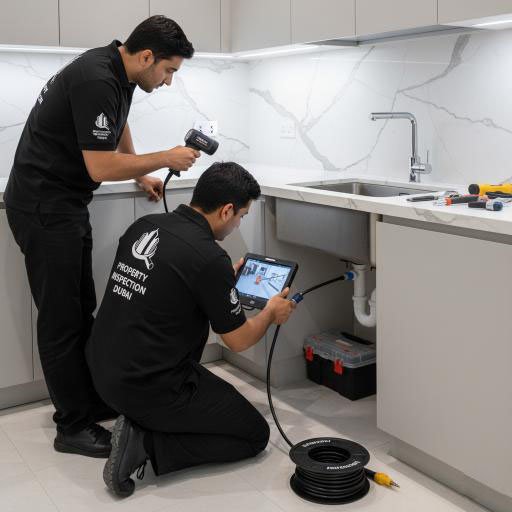
Hidden moisture detection requires more than a visual walkthrough. At Property Inspection Dubai, our moisture investigations combine:
- Thermal imaging — identifies temperature anomalies behind walls, ceilings, and floors consistent with moisture accumulation, pipe sweating, condensate pooling, and waterproofing failure
- Calibrated moisture meters — measures moisture content in walls, floors, and ceilings to quantify the extent of saturation
- AC system assessment — checks condensate drainage gradients, pipe insulation, and duct conditions for leakage risk
- Wet room inspection — physical assessment of all waterproofed areas, grout lines, sealant joints, and floor waste connections
- Mold inspection — visual and instrumental assessment for mould colonies in concealed and accessible spaces
Every finding is documented in a comprehensive report delivered within 12 hours — formatted for direct submission to your developer’s defects team or for use in a warranty claim.
Why Choose Property Inspection Dubai
Property Inspection Dubai has inspected over 44,000 properties across the UAE, with a team of certified engineers and building specialists who understand how Dubai’s construction methods and climate combine to create the specific defect patterns that affect villas and apartments here.
We are InterNACHI-certified, applying internationally recognised inspection standards on every assessment. Our reports are detailed, photographic, and built to give you the documented evidence you need — not just to identify problems, but to get them fixed.
When you smell something wrong in your new villa, we find out exactly what it is.
Book Your Moisture and Mold Inspection Today
A damp smell in a new villa is not a minor inconvenience. It is an early warning that moisture is active inside your structure — and in Dubai’s climate, early action is everything.
Property Inspection Dubai offers professional moisture, mold, and full property inspections across Dubai, with thermal imaging included as standard and comprehensive reports delivered within 12 hours.
📞 Call or WhatsApp us today to book your inspection. Find the source. Fix it under warranty. Protect your investment.
