Construction Quality Monitoring in Dubai: How Site Inspections During Renovation Protect Your Budget
Ask anyone who’s renovated in Dubai what the project cost, and you’ll get two numbers. The figure on the contract and the real one, after the surprises. The gap between those two numbers almost always comes down to a single question: was anyone monitoring the work while it happened?
Most renovation budgets don’t blow up because of expensive taste. They blow up because of rework. A drainage line laid at the wrong slope. Tiles fixed over a floor that was never levelled. Wiring that fails testing after the walls are closed. Each of these is cheap to correct on the day it happens and painfully expensive to correct three months later.
That’s the case for construction quality monitoring in Dubai in one sentence: paying a professional to catch mistakes early is dramatically cheaper than paying a contractor to undo them late. At Property Inspection Dubai, our engineers carry out scheduled site inspections during renovation projects across the city apartments, villas, offices, and retail fit-outs — so our clients only ever pay for work done right the first time.
The Real Cost of Unmonitored Construction Work
There’s a rule of thumb in construction economics that every project manager knows: the later a defect is discovered, the more it costs to fix. Not slightly more. Multiples more.
Take a simple example. A plumber installs a shower drain 15mm too high. Caught on inspection day, the correction takes an hour and costs nothing the contractor simply redoes it. Discovered after tiling? Now you’re paying to break the floor, redo the screed, re-waterproof, re-tile, and repaint the splash damage. Discovered after you’ve moved in, when water starts pooling? Add furniture removal, hotel nights, and a dispute over who pays.
The defect never changed. Only the timing did.
This is why construction defect inspection in Dubai shouldn’t be treated as a single event at the end of a project. By handover, the most expensive category of defects the ones inside floors, walls, and ceilings — can no longer be seen, only suffered. An independent property inspector in Dubai visiting at the right milestones sees each layer of the building before the next one hides it.
There’s a second cost most owners never calculate: payments released for incomplete work. Contractors typically invoice against milestones. Without verification, you’re approving payments based on a WhatsApp photo and a promise. Milestone-linked inspection puts an engineer between your money and that invoice.
What Site Inspections During Renovation Actually Cover
Our renovation quality control in Dubai service is structured around your project’s milestones rather than the calendar. Before each payment stage and before each “cover-up” moment — when work is about to be concealed an inspector visits, tests, and reports.
Civil & Structural Works
Blockwork alignment, plaster thickness and flatness, screed levels, and any structural alterations checked against the approved drawings. If a wall has moved 100mm from where the plan says it should be, you’ll hear it from us before the electrician wires around it.
MEP Installations
The mechanical, electrical, and plumbing stage is where budgets go to die quietly. We verify pipe routing and sizes, drainage gradients, pressure testing results, cable specifications, DB configurations, and AC duct installation — all while the ceiling is still open and the walls are still bare. This kind of construction milestone inspection is the single highest-value visit in any project.
Finishes & Fit-Out
For an interior fit-out quality check, we examine tiling, joinery, painting, gypsum works, doors, ironmongery, and sanitary installation against the finishes schedule. Every deviation is photographed, graded by severity, and logged with its location — so your contractor receives a punch list, not a complaint.
Each visit ends the same way: a report in your inbox that tells you three things. What’s compliant. What isn’t. And whether the next payment is justified. That’s renovation payment stage inspection doing its job — turning your payment schedule into a quality control mechanism.
Building Material Verification: Spec vs. Site Reality
Your bill of quantities says one thing. What’s stacked in the corridor outside your unit might say another.
Material downgrading is rarely dramatic. Nobody swaps marble for concrete. What actually happens is subtler — a “similar” tile from a cheaper factory, a paint one grade below the specified line, a waterproofing product that costs a third of the branded system in your contract, generic cable where a specific standard was priced. The finished surface looks identical for the first year. The pricing difference went into someone else’s pocket, and the performance difference shows up in yours.
Our building material verification in UAE projects follows a paper-first, product-second method:
- Every delivery is matched against the BOQ line item: manufacturer, product code, grade, and quantity
- Packaging, batch numbers, and conformity certificates are photographed and archived
- Perishable materials — adhesives, waterproofing compounds, cementitious products — are checked for expiry and correct storage
- Anything that doesn’t match the specification gets flagged in writing before installation, not after
The documentation matters as much as the checking. If a dispute ever reaches your contractor’s office — or a courtroom — you’ll hold a dated, photographed evidence trail instead of a memory.
Inspection Technology That Finds What Eyes Can’t
Experience tells an inspector where to look. Instruments tell everyone else what he found. On every monitoring visit, our team works with a calibrated toolkit designed to make defects measurable and undeniable.
Infrared thermography. An infrared camera building inspection converts temperature differences into images, exposing what’s happening beneath surfaces: moisture migrating behind a bathroom wall, insulation voids around AC ducting, a loose electrical connection heating up inside a DB. If a contractor insists a wall is dry, the thermal image settles the conversation.
Moisture measurement. Professional damp testing of walls and screeds tells us whether a substrate is genuinely ready for the next stage. Tiling over a wet screed or painting over damp plaster guarantees failure — bubbling, debonding, mould usually within the first year. A sixty-second reading prevents all of it.
Tile hollowness testing. The tile hollowness test is old-school and irreplaceable: systematically sounding each tile to detect voids in the adhesive bed beneath. Hollow tiles crack under point loads and debond with thermal movement. On a typical inspection, we map every hollow tile on a floor plan so the contractor knows precisely which ones to lift.
Level, plumb, and alignment instruments. Digital levels and laser lines measure what casual glances miss — a floor falling the wrong way toward a bedroom instead of a drain, a wall leaning enough to fight every wardrobe you install, ceiling bulkheads that wander off line.
None of this equipment is exotic. What’s rare is bringing it to a site during the work, systematically, at every stage that matters.
A Story From Site
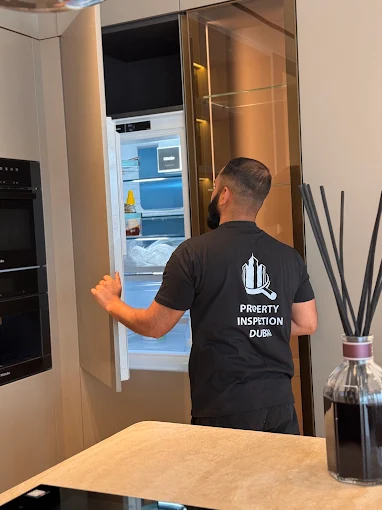
During a apartment renovation inspection in Dubai Marina last year, our engineer arrived for a scheduled pre-payment milestone visit. The contractor’s invoice claimed the electrical first-fix was complete and requested 25% of the contract value.
Testing told a different story. Nearly a third of the power circuits weren’t continuous, two bathroom points had no earth connection at all, and the cable in the kitchen ring didn’t match the specification the client had paid for. On paper, the milestone was “done.” Electrically, it was a hazard wearing a progress report.
The payment was held. The contractor re-pulled the non-compliant cable and corrected the earthing within a week at their cost, because the defects were documented before money changed hands. The client’s total exposure: zero dirhams and a seven-day delay. Without that visit, the same discovery would have arrived via tripping breakers in a finished, occupied apartment.
Independent Means Answering Only to You
Monitoring only works when the person doing it has nothing to gain from the result. Our inspectors are not affiliated with any contractor, developer, or supplier in the UAE. We don’t recommend “our guys” to fix what we find, and no one on site can influence what goes in the report. Our certified engineering team inspects to international standards, and every finding good or bad reaches you exactly as it was recorded.
As an established home inspection company in Dubai, we’ve built our name on one simple idea: the report you receive should read the same whether the contractor is standing next to us or not.
Monitor the Work, Not Just the Result
A renovation is a series of moments where quality is either built in or covered up. Once the plaster dries and the tiles set, your options shrink and your costs multiply. Construction quality monitoring in Dubai keeps those options open — stage by stage, payment by payment, delivery by delivery.
If you’re planning a renovation or your project is already underway, the best inspection is the one that happens before the next layer goes on.
Contact Property Inspection Dubai today for a milestone-based inspection plan tailored to your project — and make every payment a verified one.
