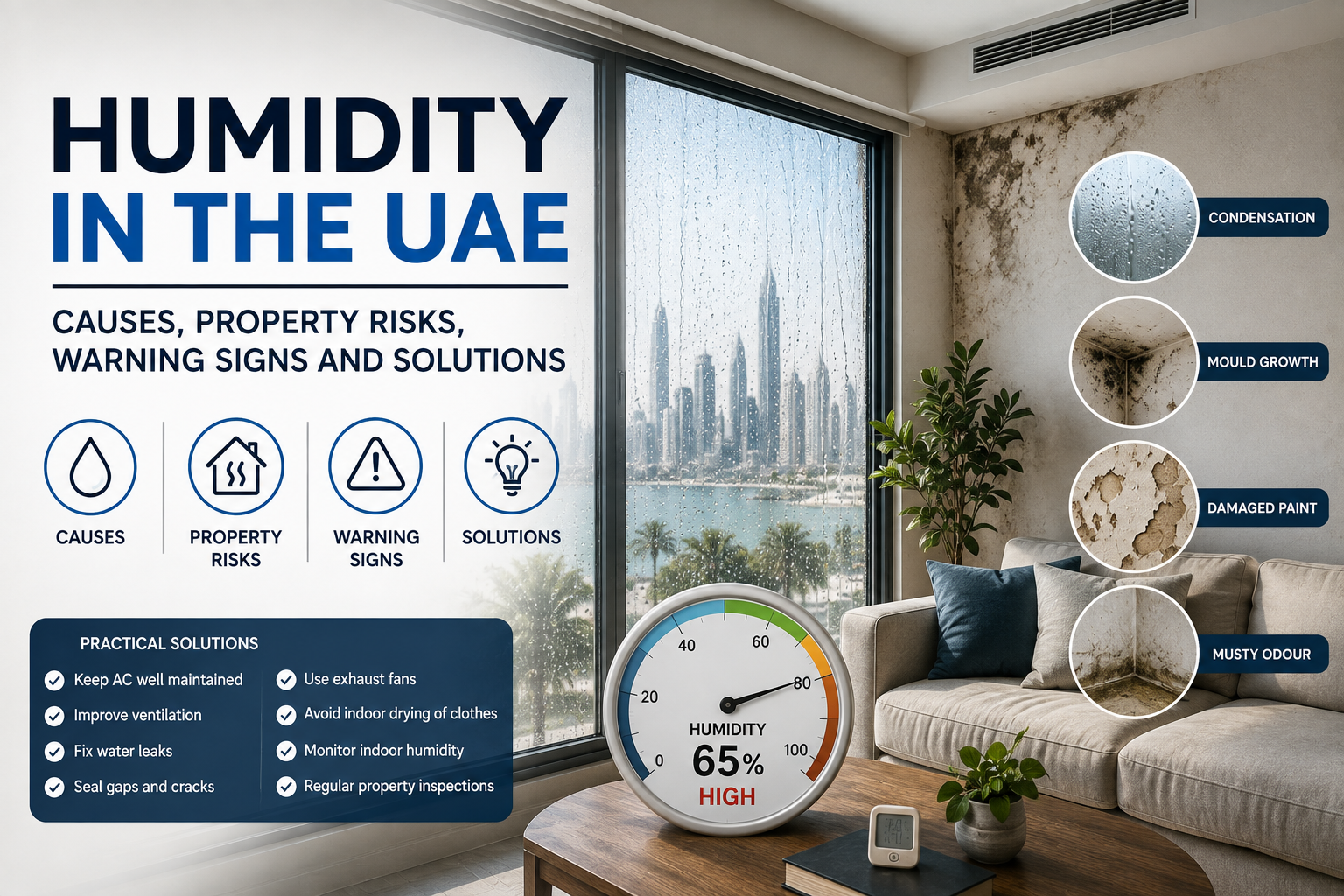
Anyone living in the UAE knows the feeling: you step outside in summer and the air feels heavy almost immediately. In coastal cities such as Dubai, Abu Dhabi, Sharjah and Ajman, humidity can become especially noticeable during the warmer months.
But there is an important difference between humid weather outside and a humidity problem inside your property.
A well-functioning home should remain reasonably comfortable even when outdoor humidity is high. If your apartment or villa constantly feels damp, smells musty, develops condensation, or shows signs of mould and peeling paint, the issue may be related to more than just the UAE climate.
This guide explains what high humidity means for UAE properties, how to recognise a problem, and when it makes sense to arrange a professional inspection.
First: What Does “Humidity” Actually Mean?
Humidity is simply the amount of moisture in the air.
When people talk about indoor humidity, they usually mean relative humidity, which tells us how much moisture the air is holding compared with the maximum amount it could hold at that temperature.
The interesting part is that two rooms can feel completely different even when their temperatures are similar.
For example:
| Room Condition | Temperature | Humidity | How It May Feel |
|---|---|---|---|
| Comfortable bedroom | 22–24°C | Moderate | Cool and comfortable |
| Cool but humid room | 22–24°C | High | Cold, damp and heavy |
| Warm, ventilated room | 25–26°C | Moderate | Warmer but less sticky |
| Poorly ventilated bathroom | 24–26°C | Very high | Damp, stuffy, condensation likely |
This is why turning the AC colder does not always solve a humidity problem.
Why Is Humidity Such a Common Topic in the UAE?
The UAE combines several conditions that make humidity a major property concern:
High outdoor temperatures + moisture from the Gulf + heavily air-conditioned interiors.
That combination creates a large difference between the indoor and outdoor environment.
When warm, moisture-rich air finds its way into a cooler property, condensation can form on colder surfaces. If this continues regularly, the result may be staining, mould, paint damage or deterioration of finishes.
Humidity can enter or build up through several routes, including open doors, poorly sealed windows, bathrooms, cooking, drying clothes indoors, AC problems and hidden water leakage.
Outdoor Humidity vs Indoor Humidity
This distinction is one of the most important things for property owners to understand.
| Outdoor Humidity | Indoor Humidity |
|---|---|
| Mainly affected by weather and location | Affected by AC, ventilation, leaks and building condition |
| Can become very high during UAE summer | Should still be managed by the property systems |
| Usually temporary and weather-dependent | Persistent high levels may indicate a property issue |
| Cannot be controlled by the homeowner | Can often be improved through maintenance or repairs |
So, if the weather outside is humid, some increase indoors is expected.
But if your property continues to feel damp every day, even with the AC running, it is worth investigating.
“My AC Is Cold, So Why Is the House Still Humid?”
This is one of the most common questions property owners ask.
Air conditioning does not only cool the room. It also helps remove moisture from the air.
However, an AC system can sometimes make a room feel cold without dehumidifying it effectively.
This may happen when there is:
- Low or inconsistent airflow
- Poor return-air circulation
- Dirty filters or coils
- Condensate drainage issues
- Incorrect system operation
- Short cycling
- Poor AC balancing between rooms
A good example is a bedroom that feels cold at night but still has condensation on the window in the morning.
That usually means temperature alone is not telling the full story.
What Is Normal and What Should Concern You?
Not every bit of condensation or humidity is a serious defect.
Here is a simple comparison:
| Situation | Usually Normal? | Needs Investigation? |
|---|---|---|
| Slight condensation during extremely humid weather | Sometimes | If it disappears quickly, usually not urgent |
| Bathroom mirror fogging after a hot shower | Yes | Only if moisture remains for a long time |
| Bedroom feels damp every day | No | Yes |
| Musty smell inside wardrobes | No | Yes |
| Paint bubbling or peeling repeatedly | No | Yes |
| Mould returning after cleaning | No | Yes |
| Water marks growing on a ceiling | No | Yes |
| AC grille dripping regularly | No | Yes |
| One room much more humid than others | Not usually | Yes |
The key word is persistent.
An occasional humidity-related symptom is very different from a problem that keeps returning.
The Difference Between Humidity, Condensation and a Water Leak
These three problems are often confused.
Humidity
Humidity refers to moisture present in the air.
A room can have high humidity without any visible water leak.
Condensation
Condensation occurs when humid air meets a colder surface.
Think of the water droplets that appear on the outside of a cold bottle.
Inside a UAE property, this may happen around windows, AC grilles, chilled pipes or cold wall surfaces.
Water Leakage
A leak means liquid water is entering from a plumbing line, waterproofing defect, roof, neighbouring unit or another physical source.
Here is an easy way to compare them:
| Issue | Typical Sign | Common Cause |
|---|---|---|
| High humidity | Damp feeling throughout room | AC, ventilation, external air |
| Condensation | Water droplets on cold surfaces | Temperature difference |
| Hidden leakage | Localised damp patch or staining | Plumbing or waterproofing issue |
Sometimes all three can exist at the same time, which is why proper inspection is useful.
Warning Signs You Should Not Ignore
A humidity issue usually starts quietly.
You may first notice a smell, a small paint mark or condensation near an AC grille.
Over time, more visible symptoms can appear.
Common examples include damp corners, peeling paint, black mould spots, swelling wooden doors, damaged wardrobes, rusting metal fittings and recurring staining.
One useful clue is location.
If a problem appears only around one bathroom wall, plumbing may be involved.
If several rooms feel damp, AC or ventilation may be more likely.
If the issue appears mainly around external windows, air infiltration or condensation may be contributing.
How High Humidity Can Affect a Property
Many people think humidity is mainly a comfort problem.
In reality, prolonged moisture can affect multiple parts of a building.
| Property Element | Possible Effect |
|---|---|
| Painted walls | Bubbling, peeling, staining |
| Ceilings | Discolouration, mould, deterioration |
| Wooden doors | Swelling or sticking |
| Wardrobes | Musty odour, damaged panels |
| Metal fittings | Corrosion or rust |
| Silicone and grout | Faster deterioration |
| Furniture | Moisture absorption and odour |
| AC areas | Condensation and staining |
The longer the source remains unresolved, the more likely repairs become repetitive.
Why Mould Keeps Coming Back After Cleaning
A common mistake is to treat mould as a cleaning problem only.
You clean the wall, repaint the area, and within a few weeks the marks appear again.
This usually means the moisture source was never corrected.
Mould is often a symptom, not the root cause.
If an external wall stays damp, a bathroom remains poorly ventilated or an AC system continues creating excessive condensation, cleaning the surface alone will not provide a lasting solution.
Villas and Apartments Can Have Different Humidity Problems
Humidity does not behave exactly the same way in every property.
Villas
Villas usually have more external walls, roof exposure, doors, windows and separate AC zones.
This means potential sources can include roof moisture, external wall penetration, window sealing, unused rooms, AC imbalance between floors and bathroom ventilation.
Apartments
Apartments can be affected by neighbouring units, building shafts, shared plumbing systems, fan coil units and common drainage.
A wet ceiling in an apartment, for example, may originate from a property above rather than from the affected apartment itself.
A Realistic Example
Imagine a 3-bedroom villa where the owner notices that one bedroom always feels damp.
The AC is working and the room temperature feels cool.
However, the wardrobe smells musty and paint near one external corner has started to bubble.
A basic visual check may suggest “humidity.”
But further inspection might reveal one of several possibilities:
The AC airflow could be weak. The window perimeter could be allowing humid air inside. Moisture could be entering through the external wall. Or there could be a concealed plumbing issue nearby.
This is why guessing the cause based on one visible symptom can lead to the wrong repair.
How Property Inspectors Investigate Humidity
A proper humidity investigation usually combines several methods rather than relying on one tool.
Humidity readings can be compared between rooms.
Thermal imaging can help locate unusual temperature patterns.
A moisture meter can check whether suspicious walls or ceilings contain elevated moisture.
The AC system can be assessed for airflow, cooling behaviour and visible condensation.
Bathrooms, kitchens, ceilings and external openings can also be checked for leakage or sealing defects.
The goal is not simply to prove that humidity exists. The useful part is identifying where the problem may be coming from.
Thermal Imaging vs Moisture Meter: What Is the Difference?
These tools are often confused.
| Tool | What It Helps Detect |
|---|---|
| Thermal imaging camera | Temperature differences and suspicious patterns |
| Moisture meter | Elevated moisture within or near a surface |
| Hygrometer | Humidity level in the air |
| Visual inspection | Physical defects, staining and deterioration |
Thermal imaging does not automatically mean “there is a leak.”
It helps an inspector identify areas that deserve closer investigation.
The moisture meter can then provide additional information.
What Can You Do Before Calling an Inspector?
If your property feels humid, there are a few simple things you can check first.
See whether the AC filters are clean.
Check if bathroom exhaust fans are operating.
Look for visible leaks under sinks and around sanitary fixtures.
Avoid keeping windows or balcony doors open for long periods during very humid weather.
Check whether one room is noticeably worse than the others.
Also look behind large wardrobes and furniture placed against external walls.
If the problem continues after basic maintenance, a more detailed investigation is sensible.
Should You Buy a Dehumidifier?
A dehumidifier can help reduce moisture in the air, especially in rooms with poor circulation.
But it should not automatically be treated as the permanent solution.
If the real cause is a water leak, damaged waterproofing, poor AC drainage or outside air entering through gaps, a dehumidifier may only control the symptom.
It is useful as a moisture-control tool, but the underlying cause still needs attention.
When Should You Arrange a Professional Property Inspection?
A professional inspection becomes especially useful when the issue is recurring or the source is unclear.
For example, if you have already repainted a wall twice and the stain keeps returning, another coat of paint is probably not the answer.
The same applies if mould keeps coming back, an AC grille repeatedly drips, or one room consistently feels much more humid than the rest of the property.
At that stage, investigating the cause can save money compared with repeatedly repairing visible damage.
Final Takeaway
Humidity is part of life in the UAE, but persistent dampness inside a property should not automatically be accepted as “normal Dubai weather.”
A properly functioning property should be able to manage indoor moisture through effective air conditioning, ventilation, drainage and building sealing.
The most important thing is to distinguish between normal outdoor humidity and an indoor moisture problem caused by the property itself.
If you are seeing recurring condensation, mould, paint deterioration, damp walls or unexplained moisture, the best approach is to identify the source before spending money on cosmetic repairs.
PropertyInspectionDubai.ae provides professional property inspections in Dubai, including humidity assessment, moisture detection, thermal imaging and investigation of suspected hidden property defects.
